About Ateles geoffroyi Kuhl, 1820
Taxonomic Identity
Geoffroy's spider monkey (Ateles geoffroyi Kuhl, 1820) is one of the largest New World monkeys.
Body Size
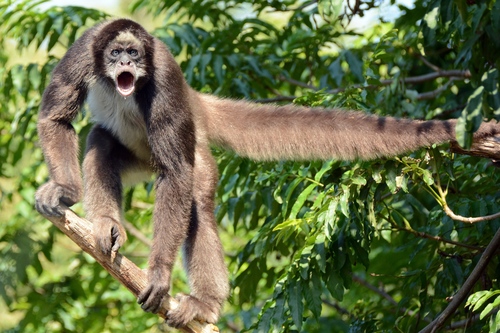
Its body measures 30 to 63 cm (12 to 25 in) long and weighs 6 to 9 kg (13 to 20 lb). Its prehensile tail is longer than its body, ranging from 63 to 85 cm (25 to 33+1⁄2 in). Males and females are approximately the same size.
Body Coloration
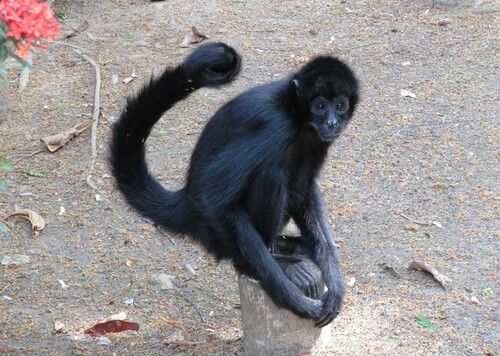
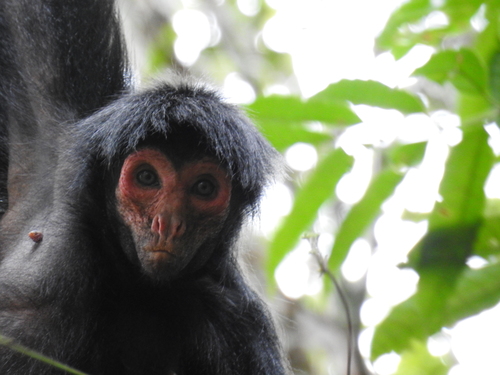
Body color varies by subspecies and population, and can be buff, reddish, rust, brown or black. The hands and feet are dark or black, and the face usually has a pale mask with bare skin around the eyes and muzzle.
Limb Morphology
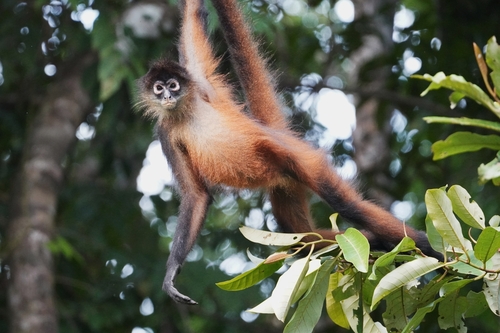
Its arms and legs are long and slim, with arms about 25% longer than legs. The thumb is only vestigial, while the fingers are long and strong, giving the hands a hook-like shape.
Brachiation Adaptation
These long arms and hook-like hands allow Geoffroy's spider monkey to brachiate, meaning it swings by its arms beneath tree branches.
Prehensile Tail Structure
The prehensile tail is very strong and has a palm-like pad at the end.
Prehensile Tail Function
It acts as an extra limb, used for locomotion, picking fruits, and scooping water from holes in trees. Geoffroy's spider monkey can support its full body weight suspended by its tail, and often does this while feeding.
Female Genital Morphology
Female Geoffroy's spider monkeys have a large, protruding pendulous clitoris that resembles a penis. This organ is actually larger than the male's flaccid penis, so human observers sometimes mistake females for males.
Clitoris Function
Researchers believe the enlarged clitoris helps males determine female sexual receptiveness: males touch the clitoris then smell their fingers to pick up chemical or olfactory cues about the female's reproductive status.
Core Range
The species' range covers most of Central America, including Panama, Costa Rica, Nicaragua, Guatemala, Honduras, El Salvador, Belize, and the southern and much of the eastern portion of Mexico.
Southern Range Extension
Local observations suggest the southernmost subspecies, the hooded spider monkey A. g. grisescens, may also occur in the area of Colombia near the Panama border.
Related Species Distribution
In western Colombia and northeast Panama, Geoffroy's spider monkey is replaced by the black-headed spider monkey A. fusciceps, which some primatologists classify as a subspecies of Geoffroy's spider monkey.
Habitat Types
Geoffroy's spider monkey lives in multiple types of forest, including rainforest, semideciduous forest, and mangrove forest. It generally reaches higher population densities in areas with evergreen forest.
Reproductive Interval
Females give birth to young every two to four years.
Mating Patterns
Mating is not restricted to only dominant males; one study on Barro Colorado Island found all males in a group mated at least once over a one-year period, though dominant males do tend to mate more often than lower-ranking males. It remains unknown whether male dominance correlates with higher success in fathering offspring.
Mating Posture
Geoffroy's spider monkeys mate in a sitting position, with both facing the same direction. The male sits behind the female, wraps his arms around her chest and his legs around her waist, and this mating embrace lasts between 8 and 22 minutes.
Pre-Mating Behavior
Before mating, the male and female both leave the rest of their group to be alone, except for any of the female's juvenile offspring.
Gestation and Birth
Gestation lasts approximately 7.5 months, and most births result in a single young, though twins occasionally occur.
Infant Development
Infants are dark in color and begin developing adult coloration at five months old. For the first one and a half to two months, infants are carried on their mother's chest, after which they can ride on her back.
Juvenile Development
They nurse until they are around one year old, but start eating solid foods and moving independently at about three months old. Even when moving independently, juveniles cannot always cross canopy gaps that adults can manage.
Canopy Gap Behavior
To help, an adult will stretch across the gap to form a bridge for the young to cross.
Sexual Maturity Age
Females reach sexual maturity at around four years old, and males reach sexual maturity at around five years old.
Dispersal Pattern
When they reach sexual maturity, females leave their natal group, but males stay behind.
Group Relatedness
As a result, males in a group are typically related to each other, while females are not closely related to other group members. This pattern may explain why male Geoffroy's spider monkeys form strong social bonds.
Life Span
Maximum life span in the wild is not known, but the species can live at least 33 years in captivity.