About Astragalus succumbens Douglas ex Hook.
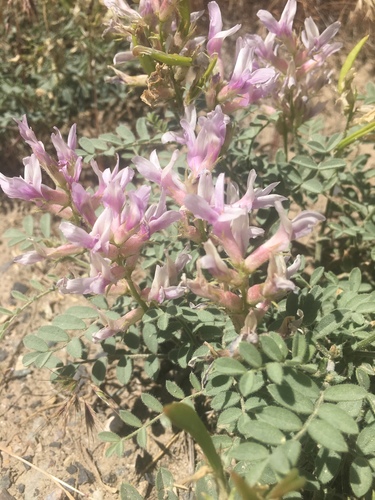
Astragalus succumbens Douglas ex Hook. is a small to medium-sized sprawling plant that grows from a long taproot. It produces multiple stems with alternate compound leaves. Each leaf can reach up to around 10 cm (3.9 in) long, and is made up of multiple paired leaflets plus one terminal leaflet. Individual leaflets are shaped obovate to elliptic, typically with an acute tip, measuring 5 to 19 mm (0.20 to 0.75 in) long, and are densely hairy on their upper surface. This species bears erect racemes of flowers in leaf axils. Flowers are usually light pink with a darker center, though they may sometimes be light purple or nearly white. Their structure is characteristic of the legume family, with distinct banner, wing, and keel petals. The flower calyx is covered in stout hairs and has long, pointed tooth-like lobes. The seed pods are curved and hairless, held either erect or angled upward, and grow up to 40 mm (1.6 in) long and 7 mm (0.28 in) wide. Young pods are shiny green, and turn reddish brown as they mature. This species is found in the Columbia River valley of northern Oregon and south-central Washington. It typically grows in sandy soils in sagebrush stands and in somewhat barren open areas.