About Astragalus coccineus (Parry) Brandegee
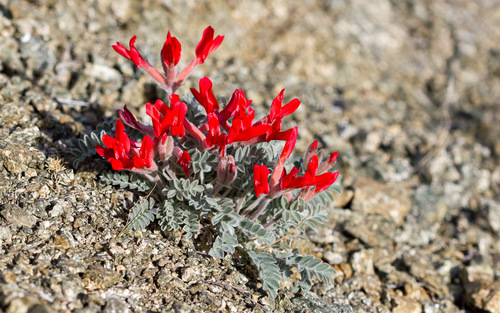
Astragalus coccineus (Parry) Brandegee is a clumpy perennial herb that is thickly coated in white hairs. Its leaves can grow up to 10 centimeters long, and are composed of oblong, pointed leaflets. This species can be distinguished from most other milkvetches by its large, bright scarlet flowers. The inflorescence holds up to 10 flowers, each 3 to 4 centimeters long or longer. The fruit is a plump legume pod that dries to a hairy, leathery texture, and reaches up to 4 centimeters long. Astragalus coccineus is highly toxic, and its blooming season runs from March to June. This plant is distributed across the desert mountains of east-central California, southwestern Nevada, northwestern Arizona, and northern Baja California. It grows in gravelly soil within sagebrush scrub and pinyon-juniper woodland communities, and is most commonly encountered in March, April, and May. It has a global conservation status of G3, meaning it is considered vulnerable. Ecologically, the red color and elongated shape of this species' flowers attract hummingbirds. It also acts as a host plant for four butterfly species: Reakirt's blue, arrowhead blue, marine blue, and Queen Alexandra's sulphur.