About Astianthus viminalis (Kunth) Baill.
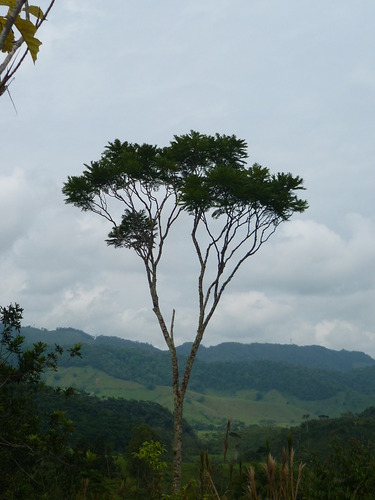
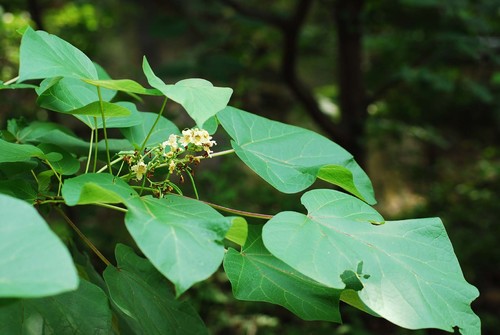
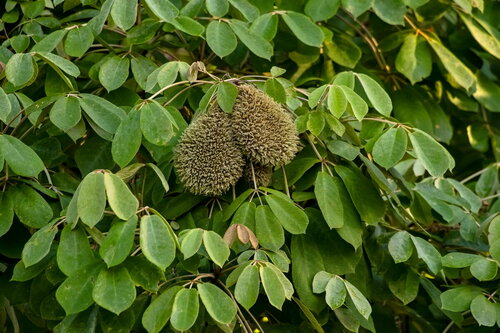
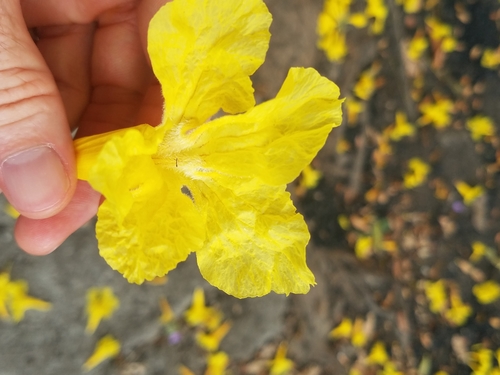
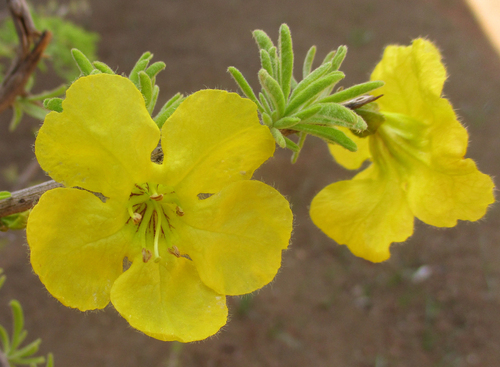
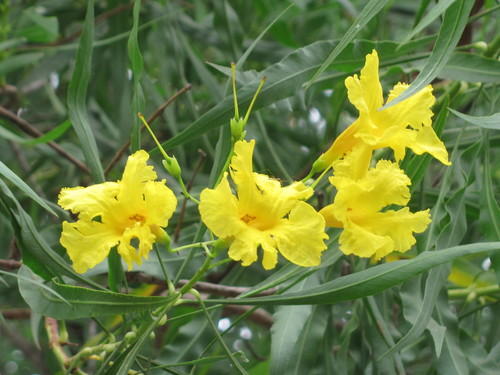
The description of Astianthus viminalis (Kunth) Baill. is excerpted from Flora Neotropica. It grows as a tree or shrub, reaching 2 to 20 meters in height. Its leaves are arranged in whorls of three, are simple and linear in shape, measuring 6 to 30 centimeters long and 0.3 to 1.4 centimeters wide. The midrib is prominent, and the secondary veins are numerous and strongly ascending. Inflorescences are terminal and paniculate, with lateral branches arranged in whorls of three. The calyx is campanulate and 5-toothed, with teeth 1 to 3 millimeters long. The corolla is yellow, 4 to 5.5 centimeters long, shaped from tubular to infundibuliform, with a narrowly tubular base. The stamens are didynamous. The gynoecium is 2.5 to 3 centimeters long, with a glabrous ovary whose base is surrounded by a nectariferous disk. The fruit is fusiform, terete, and glabrous, 3 to 8 centimeters long. The true septum is perpendicular to a false septum, making the combined structure cruciform in cross section. Seeds are small, positioned perpendicular to the true septum and parallel to the false septum; the seed body is sharply demarcated from its wing. When Astianthus reaches its largest size, it can produce usable lumber, but it is rarely harvested by lumberjacks. Medicinal properties have been claimed for this plant, but no verifiable evidence of efficacy has been found. Isolated compounds and crude extracts from Astianthus have not shown any antimicrobial activity, and also demonstrated no cytotoxicity against tumor cells.