About Aspidoscelis uniparens (Wright & Lowe, 1965)
Description
Size and Build
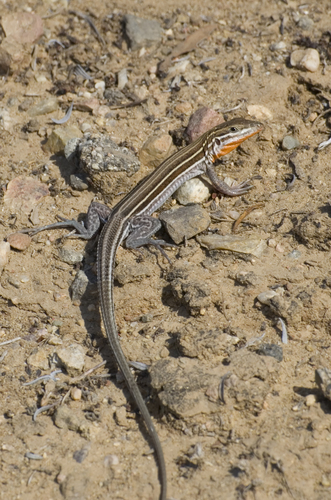
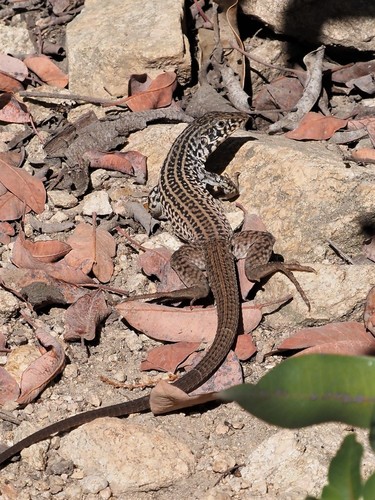
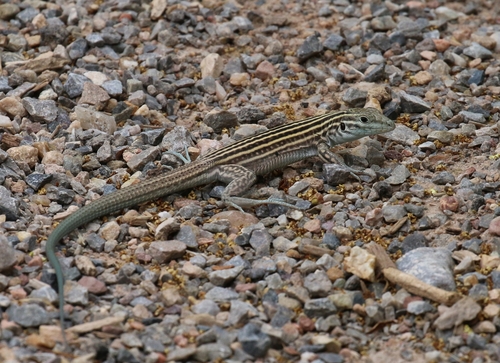
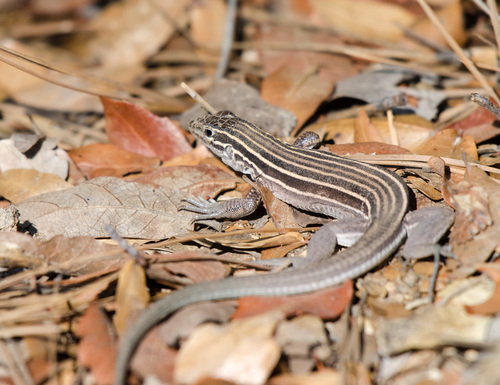
The desert grassland whiptail lizard (Aspidoscelis uniparens) is a relatively small reptile, with a total length ranging from 2+3⁄4 to 5+1⁄4 inches (7.0 to 13.3 cm). This species is very long and slim, with a thin tail that is longer than its body length.
Body Markings
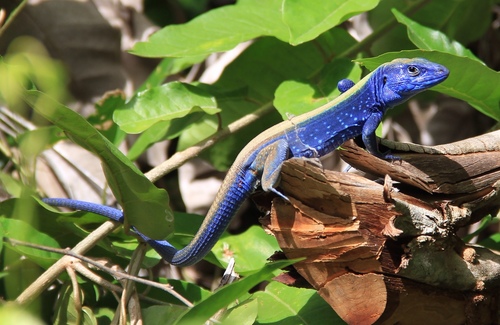
Its most distinct identifying feature is six yellowish lines that run the full length of the body. The majority of the body is typically olive or brown in color, which fades to a faint blue or gray on the tail; by comparison, the tail of adolescent individuals is a very bright, vibrant blue.
Scale Characteristics
The body is covered in small coarse scales, which gradually get larger approaching the tail. The scales on the belly are much larger, and also much smoother.
Habitat
Geographic Range
The desert grassland whiptail lizard is mostly found in the deserts of southern to central Arizona and along the Rio Grande in New Mexico, and also occurs in the deserts of northern Mexico.
Preferred Environments
A. uniparens is commonly found in low valleys, grasslands, and slight slopes. Some researchers have argued that the species' range is expanding due to overgrazing.
Population Distribution Limitations
A. uniparens is scarce in developed areas, especially where homeowners keep livestock.
Hybridization and reproduction
All-Female Species Trait
All desert grassland whiptail lizards are female. Their reproduction does not require male fertilization, although researchers have observed pseudo-copulation that promotes fertilization during ovulation.
Mating Behavior
This process involves both lizards alternating between male-typical and female-typical sexual behaviors driven by progesterone, which corresponds to the current state of their partner.
Parthenogenesis Mechanism
The lizards reproduce via parthenogenesis, and all offspring are clones of their mother. In typical sexual reproduction, each chromosome pair is separated, copied, and paired back with its counterpart.
Genetic Diversity Adaptation
However, the desert grassland whiptail lizard has chromosome triplets, where each triplet is paired with its copy rather than its counterparts. This reproductive method allows the asexual desert grassland whiptail lizard to maintain a level of genetic diversity previously thought to be unique to sexually reproducing species.
Hybrid Origin
This species originated from a cross between two bisexual species, Aspidoscelis inornata and Aspidoscelis burti. This cross first produced a diploid unisexual lineage, which backcrossed with A. inornata to produce the triploid unisexual A. uniparens.
Food habits
Burrowed Prey
For the most part, desert grassland whiptail lizards dig to prey on termites, queen ants, beetles, and other unidentified insects.
Above-Ground Prey
A smaller portion of their diet consists of prey caught above ground, such as grasshoppers and butterflies.