About Asarina procumbens Mill.
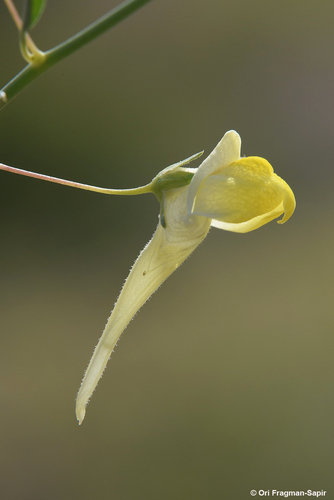
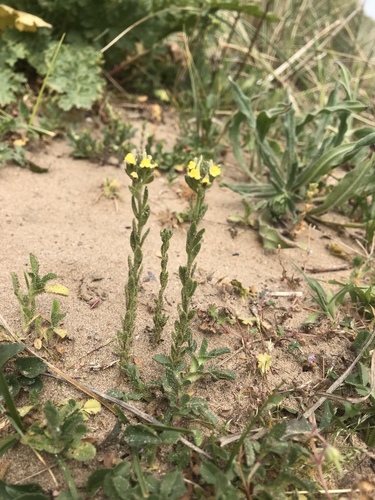
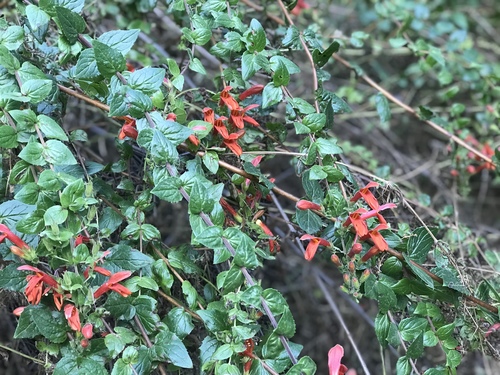
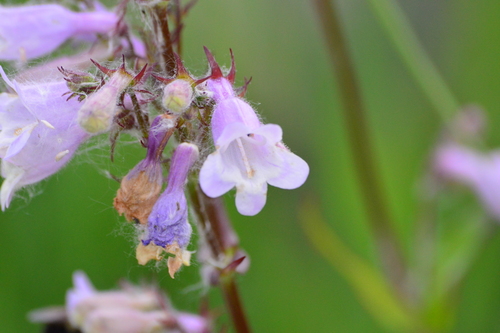
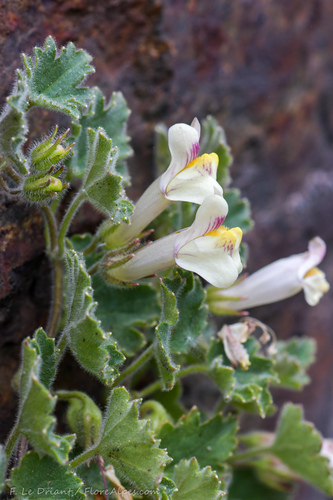
Asarina procumbens Mill. is the only remaining species in the now monotypic genus Asarina. It is a bad-smelling, strongly hairy, sticky subshrub that grows as a trailing mat, reaching only 10 to 20 centimetres in height. Its somewhat woody main stems produce loose creeping or cascading stems that carry opposite, long-stalked, hairy, lobed leaves. The leaves are shaped from kidney-shaped to heart-shaped, with scalloped, often red-tinged margins. Flowers grow singly or in short racemes of only two or three flowers, and are fragrant and pollinated by bumblebees; they are produced in leaf axils. The corolla is cream-coloured and somewhat resembles that of Antirrhinum. Its tube has faint violet stripes, its upper section is split into two keel-shaped lips, and its lower section has paired inflated lobes that cover the corolla tube and have a three-lobed edge. The pistil is violet and persistent, and there are four stamens. At the base of the corolla, starting behind the inflated lobes and extending into the corolla throat, there is a dense mat or beard of deep yellow hair-like structures. The calyx is tube-shaped, has five teeth, and is densely hairy. The flower stalk is narrow where it connects to the stem, thickens greatly at the junction with the fruiting calyx, and bends back to lie parallel to the seed capsule. The fruit is a dry, hairless, nearly spherical capsule that is shorter than the calyx. It splits open at the apex through two openings that separate three valves, with the persistent withered pistil attached to the central valve. The seeds are small, brownish-buff, roughly conical, and have a seed coat finely cut with deep winding grooves. Seeds are distributed by epizoochory: the sticky fruiting calyces attach to the fur of mammals or the feathers of birds, which lets the small seeds trickle out of the dry open capsules. A. procumbens is a semi-evergreen alpine chasmophyte that prefers partial shade, and grows most often in crevices of silica-rich, non-sedimentary rocks. This habitat type, 'Mediterranean siliceous inland cliff', is listed as an endangered habitat with code H3.1d on the European Red List of Habitats. In this context, siliceous cliffs are those made mostly of quartz-rich acidic rocks, which can be igneous, such as granite, diorite, and andesite, or metamorphic, such as gneiss, slate, schist, and quartzite. The low-altitude cliffs of this type that A. procumbens favours face more human disturbance than high mountain cliffs, since high mountain cliffs are often located inside nature reserves and other protected areas. Low-altitude siliceous cliffs are vulnerable to a wide range of threats, including stabilising work on cliffs above roads and railway lines, recreational activities especially rock climbing, and at lower elevations, mining, quarrying, and invasive alien plants. In the French portion of its range, A. procumbens is rarely found growing at altitudes below 400 metres, and has an upper altitude limit of around 1800 metres. A. procumbens is not a common species in the French part of its range, and it holds protected status in the Auvergne region. Its main populations in France are located in Pyrénées-Orientales, which covers the Franco-Catalan area of historic Rousillon, and the Massif Central, particularly the Cévennes. In Spain, the plant is native to the Pyrenean region, but can be found naturalised in other areas. In cultivation, A. procumbens grows best in somewhat dry partial shade. It requires well-drained, sandy or gravelly, humus-rich, moderately moist soil, and does not tolerate excessive winter wetness. It blooms most heavily in climates with not excessively hot summers. It is pollinated by bumblebees. It stays evergreen in mild climates, but may be killed by heavy frost; it self-seeds readily, so new plants can easily be grown after a dieback. It is used as a trailing alpine plant or ground cover. It grows well and increases quickly when grown as a container plant. It is not usually invasive in gardens, though there is one report of aggressive growth in the southeastern United States. Pruning is not usually required, but it can be cut back in autumn if its foliage is dead or untidy. Its hardiness rating is UK H3, and it is suited to USDA zones 8, 9, and 10.