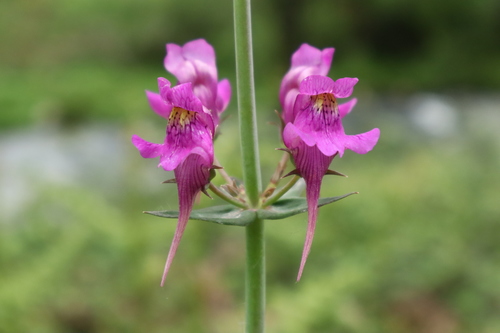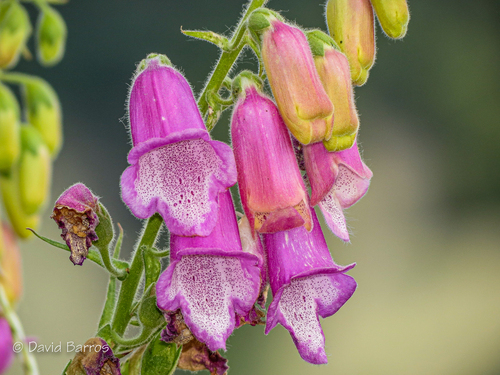
About Digitalis thapsi L.
Taxonomy and Common Name
Digitalis thapsi L., commonly called mullein foxglove in the United States, is a flowering plant species in the genus Digitalis.
Native Distribution and Commercial Status
It is endemic to the Iberian Peninsula, found in eastern Portugal and central and western Spain, and is commercially important as an ornamental plant. Successful, fertile hybrids have been created between this species and Digitalis purpurea.
General Iberian Habitat Range
As an endemic of the Iberian Peninsula, it grows in the mountains and rocky plains of central and central-western Iberia, particularly in the Sistema Central and its extensions between the Douro and Tagus rivers. It is widespread across western and central Spain, and does not grow on the Balearic Islands.
Spanish Provincial Distribution
In Spain, it can be found in the provinces of Ávila, Badajoz, Cáceres, Córdoba, Guadalajara, Madrid, Salamanca, Segovia, Soria, Toledo and Zamora, and has been found incidentally in the province of Burgos. In the Andalucía region, it only occurs uncommonly in the north, in western Sierra Morena; it has been collected more frequently in the mountains of central Spain.
Portuguese Distribution
In Portugal, it is primarily found in the northern and central interior, specifically in the districts of Bragança, Vila Real, Guarda, Viseu, Castelo Branco, Portalegre and Évora. It has also been found less often in the Porto, Aveiro, Coimbra, Santarém, Beja and Faro Districts.
Habitat Substrate and Preference
This species grows in acidic soils, on rocky ground and slopes, and prefers sunny, open, and disturbed locations. It most often grows on soils formed from granite, but can sometimes grow on soils from quartzite and schist.
Altitude Range
It grows at altitudes of 500 to 1500 metres, rarely as low as 100 metres.
Phytosociological Classification
It is a characteristic species of the phytocoenosis belonging to the phytosociological suballiance and alliance Rumici indurati-Dianthion lusitani, which falls under the order Phagnalo saxatilis-Rumicetalia indurati and the class Phagnalo saxatilis-Rumicetea indurati.
Associated Plant Species
In this habitat, it grows alongside the characteristic species Antirrhinum graniticum subsp. graniticum, Antirrhinum rupestris, Arrhenatherum fernandesii, Biscutella bilbilitana, Centaurea monticola subsp. citricolor, Centaurea pinnata, Coincya leptocarpa, Coincya longirostra, Coincya pseudoerucastrum subsp. pseudoerucastrum, Coincya rupestris, Conopodium bunioides subsp. aranii, Conopodium majus subsp. marizianum, Crepis oporinoides, Dianthus crassipes subsp. crassipes, Dianthus crassipes subsp. sereneanus, Dianthus lusitanus, both subspecies of Digitalis mariana, Digitalis purpurea subsp. toletana, Erodium mouretti, Erysimum linifolium subsp. lagascae, Festuca duriotagana, Jasione sessiliflora subsp. tomentosa, Scrophularia oxyrhincha, Scrophularia sublyrata, Sedum hirsutum subsp. baeticum, Silene marizii, Silene × montistellensis and Verbascum rotundifolium subsp. castellanum.
Flowering Period
In its native range, it flowers from June to July; when cultivated, it flowers from late spring to early summer.
Fruiting and Seed Research
A study of fruiting activity in this species found that seed production, size, and number are interrelated. Research also showed that seed weight is not correlated with cotyledon length, and that fifth leaf length can be used as a useful marker to assess genetic variability between individual specimens.
Ornamental Cultivation Basics
This species is used as a low-growing perennial ornamental plant, typically planted in garden borders. It grows well in half-shaded to full sun locations in temperate regions, and prefers organically rich, reasonably well-drained, acidic soils.
Regional Cultivation Requirements
In Missouri, it is reported to require constantly moist soil. In British gardens, it needs moderate watering, has average drought tolerance, and can adapt to dry shady areas.
Cultivation Traits and Maintenance
It is deer-tolerant. Many gardeners remove spent flower spikes shortly after blooming to prevent the plant from setting seed.
Tissue Culture Propagation
In addition to standard cultivation, D. thapsi has been propagated through explant culture, a technique that uses isolated meristem cells harvested from tissue pieces. Callus was produced when the auxins NAA, 2,4-D, and IAA were used alone or combined with BA.
Tissue Culture Hormone Effects
NAA stimulated root formation, while BA stimulated shoot formation. Combining NAA and BA induced organ generation more effectively than either alone.
Tissue Culture Survival Rate
Plantlets grown this method had a 70% survival rate.
Commercial Cultivar
A cultivar called 'Spanish Peaks', which has raspberry-rose flowers and a compact growth habit, has been available for purchase in the US.