About Arundinaria gigantea (Walter) Muhl.
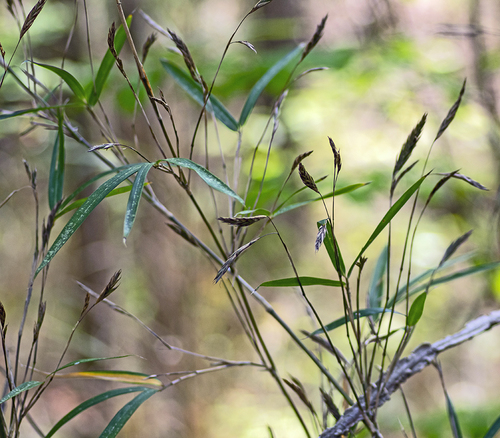
Arundinaria gigantea (Walter) Muhl. is a perennial bamboo grass, with rounded, hollow stems that can grow over 7 cm (2.8 in) in diameter and reach up to 10 m (33 ft) in height. It spreads from a large network of thick rhizomes. Its lance-shaped leaves can grow up to 30 cm (12 in) long and 4 cm (1.6 in) wide. Its inflorescence is a raceme or panicle made of 4 to 7 cm (1.6 to 2.8 in) long spikelets. Individual canes have a lifespan of approximately 10 years. Most of its reproduction happens vegetatively, as the bamboo sprouts new stems from its rhizomes; it rarely produces seeds and flowers irregularly. Writing in 1908, R.S. Cocks noted that certain clumps of this bamboo near Abita Springs, Louisiana had bloomed annually in late May for nine consecutive years. It sometimes flowers gregariously. Within its native range, this bamboo is sometimes confused with introduced non-native bamboos. Modern stands (called canebrakes) of river cane are significantly smaller in size and extent than they were historically. During the last Glacial Maximum, the species' range was restricted to a narrow strip along the Gulf Coast; after ice sheets retreated, it spread northward to its current range. Today, this native plant grows as a component of the understory or midstory in multiple plant communities. It occurs in pine forests dominated by loblolly, slash, longleaf, and shortleaf pine, as well as in stands of oaks, cypress, ash, and cottonwood. Common understory plants that grow alongside it include inkberry (Ilex glabra), creeping blueberry (Vaccinium crassifolium), wax myrtle (Morella cerifera), blue huckleberry (Gaylussacia frondosa), pineland threeawn (Aristida stricta), cutover muhly (Muhlenbergia expansa), little bluestem (Schizachyrium scoparium), and toothache grass (Ctenium aromaticum). Cane communities grow on floodplains, bogs, riparian woods, pine barrens, savannas, and pocosins, and it grows well in flooded and saturated soils. It is a fire-dependent species, with canebrakes maintained by a fire regime with 2 to 8 year intervals between burns. Giant cane provides food and shelter for 70 species, including six butterfly species that rely on it almost exclusively for food; the southern pearly eye is one such butterfly that requires giant cane as a food plant. Canebrakes are important habitat for Swainson's, hooded, and Kentucky warblers, as well as the white-eyed vireo. The loss of the canebrake ecosystem may have contributed to the rarity and possible extinction of Bachman's warbler, which depended on canebrakes for nesting sites. Giant cane was also one of three major food sources for passenger pigeons, and the disappearance of canebrakes may have helped cause the species' extinction. Invasive horizontally-spreading plants such as quackgrass can prevent giant cane from growing, but tall native plants like big bluestem and ironweed have been reported to have a positive effect on its growth. Humans use this cane for many purposes. The Cherokee, especially the Eastern Band of Cherokee Indians, use this species to make baskets. Historically, the Cherokee maintained canebrakes through cutting and periodic burning, but this practice stopped after European settlement of the region. The elimination of cane habitat has led to the near loss of the traditional basketmaking art, which is important to the modern Cherokee economy. Canebrakes have been reduced in area by at least 98%, and cane can take up to 20 years to grow to a size suitable for traditional basketry. Because of this, modern Cherokee basketmakers often lack access to the traditional material, even though Cherokee baskets are considered some of the finest in the world. The art of river cane basketry is also important to the Choctaw, whose artisans have faced the same challenges as canebrakes have disappeared. Many Indigenous groups including the Cherokee, Seminole, Chickasaw, and Choctaw used this cane to make medicine, blowguns, bows and arrows, knives, spears, flutes, candles, dwelling walls, fish traps, sleeping mats, tobacco pipes, and food. River cane is an important cultural symbol for the Choctaw nation, due to its significance to Choctaw history and its many historical uses that supported Choctaw survival. In 2022, the Cherokee Nation signed an agreement with the National Park Service to allow collection of 76 culturally important plant species including A. gigantea in Buffalo River National Park, Arkansas. Giant cane is notable for its exceptional ability to reduce both sediment loss and nitrate runoff when planted as a buffer between waterways and agricultural fields. A giant cane buffer zone can reduce nitrate pollution in groundwater by 99%. Cane stands outperform even forests as protective buffers around waterways, absorbing sediment and nitrate pollution and greatly slowing the rate at which runoff enters streams or rivers.