About Artemisia laciniata Willd.
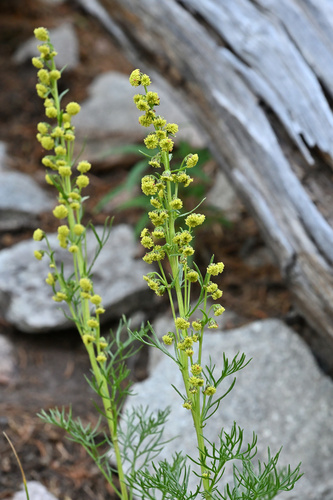
Artemisia laciniata Willd. grows to heights between 50 and 60 centimeters. It has alternate, gray-green, bipinnate leaves, with lanceolate leaflets that have smooth entire margins. This species produces numerous greenish-yellow flowers with many stellate structures, and blooms from August to October. It bears fruit as achenes, and is hermaphroditic, meaning individual plants have both male and female organs. It can be mistaken for Tanacetum bipinnatum and Artemisia norvegica; the three can be distinguished by key features: Tanacetum bipinnatum has pointed leaves, while Artemisia norvegica has larger flowers and less developed leaves. The native range of Artemisia laciniata is disputed across some regions. Its native status is undisputed in Russia (especially Siberia), Alaska, the Yukon, and Mongolia. Some sources list it as also native to Rocky Mountain states in the United States, and parts of Europe including Austria, Czechia, and Sweden. There is ongoing controversy over whether the species is now extinct in Germany, and it is also thought to be native to Kashmir. It grows in dry gravelly stream banks, grassy flats, forested areas, and dry hillsides, at elevations between 100 and 1500 meters.