About Ericameria bloomeri (A.Gray) J.F.Macbr.
Nomenclature and Classification
Ericameria bloomeri, commonly called Bloomer's rabbitbush and Bloomer's goldenbush, is a species of flowering shrub belonging to the Asteraceae family.
Geographic Distribution
It is native to mountain habitats of western North America, ranging from British Columbia in Canada south to California in the United States, and also occurs in Washington, Oregon, Idaho, and Nevada. It may have been completely extirpated from Canada.
Habitat
This species grows in coniferous forests.
Plant Size
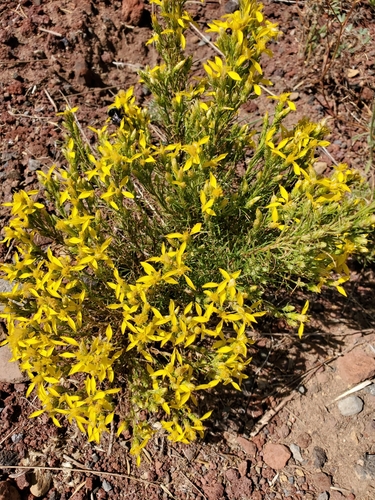
It is a small shrub that reaches a maximum height of around 50 centimeters, or 20 inches.
Leaf Characteristics
Its foliage is made up of threadlike to slightly oval leaves that are a few centimeters long.
Surface Texture
The plant may be glandular, resinous, slightly woolly, or hairless.
Inflorescence Structure
Each of its many erect branches ends in an inflorescence that holds golden yellow flower heads.
Flower Head Details
Each flower head is one centimeter wide, with up to 14 disc florets; some heads also have up to 5 ray florets, while others have no ray florets at all.
Inflorescence Texture
The dense inflorescence bears resin glands and some woolly fibers.