About Aratinga nana (Vigors, 1830)
This species, currently classified as Aratinga nana (Vigors, 1830) and commonly called the olive-throated parakeet, has three recognized subspecies. The nominate subspecies, E. n. nana, is also known as the Jamaican olive-throated parakeet.
Nominate Subspecies Size
It measures 22 to 26 cm (8.7 to 10 in) in length and weighs approximately 72 to 85 g (2.5 to 3.0 oz).
Aztec Subspecies Size
The Aztec olive-throated parakeet (E. n. astec) measures 21.5 to 25 cm (8.5 to 9.8 in) in length and weighs approximately 85 g (3.0 oz).
Sexual Dimorphism
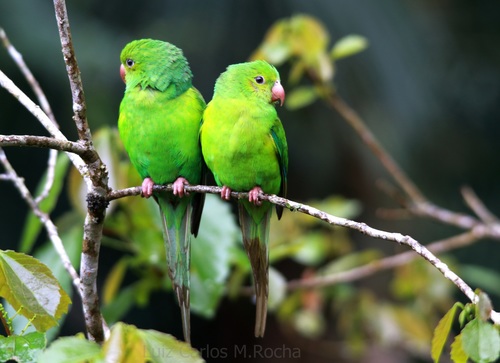
The sexes of all subspecies have identical plumage and appearance.
Nominate Adult Plumage
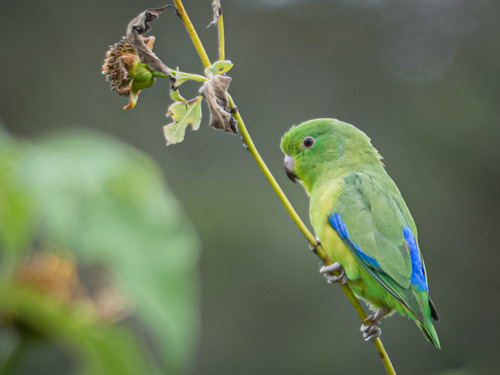
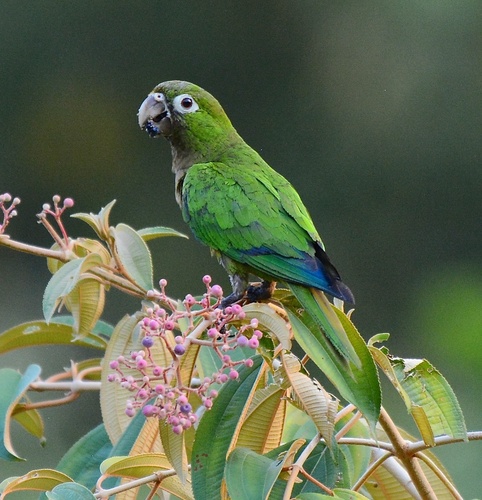
Adult nominate subspecies have mostly dark green heads and upperparts, with yellowish ear coverts and rump. Bare white skin surrounds the eye. Their throat and breast are olive-brown, fading to olive on the belly and vent.
Nominate Wing and Tail Features
Most of their wings are green, with dull blue on the upper side of flight feathers and gray on the underside. The upper surface of their tail is green, and the underside is yellowish.
Nominate Bare Parts
Their bill is brownish horn-colored with a paler tip; their iris ranges from yellow to orange, and their legs are blackish gray. Immature birds have a similar appearance to adults.
E. n. astec Plumage
The subspecies E. n. astec has paler olive-brown underparts, most noticeably on the belly and vent.
E. n. vicinalis Traits
The subspecies E. n. vicinalis is slightly larger than E. n. astec, has brighter green upperparts, and is greener on its underparts.
Population Distribution Overview
The olive-throated parakeet has two widely separated populations.
Nominate Subspecies Range
The nominate subspecies E. n. nana is naturally native to Jamaica, and has been introduced to the Dominican Republic.
E. n. vicinalis Range
Subspecies E. n. vicinalis occurs in northeastern Mexico, ranging from Tamaulipas to northern Veracruz.
E. n. astec Range
Subspecies E. n. astec occurs along the Caribbean side from Veracruz, through Guatemala, Belize, Honduras, Nicaragua, and Costa Rica, to Bocas del Toro Province in western Panama.
Primary Habitat
The principal habitat of the olive-throated parakeet is deciduous woodland.
Additional Habitats
It also lives in the interior and edges of humid forest, riparian areas, and scrublands, as well as more open landscapes including plantations, tree-dotted clearings, and gardens.
Pine Stand Use
It can be found in pine stands across its range, and this habitat is heavily used by introduced populations in the Dominican Republic.
Elevation Range
In terms of elevation range, it reaches up to 1,000 m (3,300 ft) in Mexico, 1,100 m (3,600 ft) in Honduras, 700 m (2,300 ft) in Costa Rica, and 1,500 m (4,900 ft) in Jamaica.