About Aralia nudicaulis L.
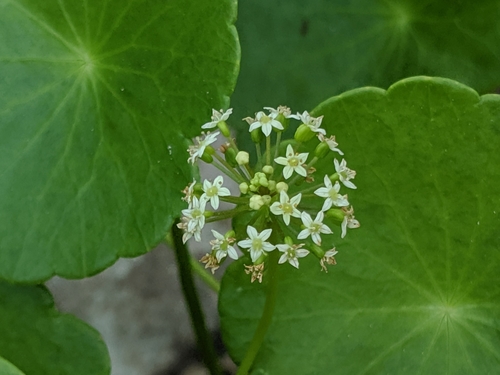
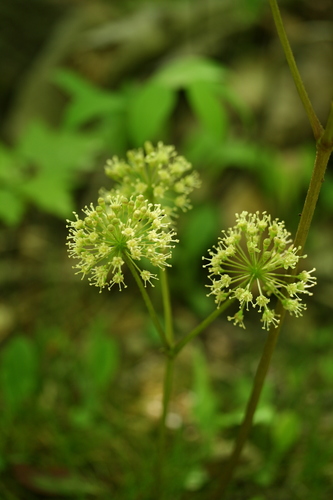
Aralia nudicaulis L. is a herbaceous perennial plant with creeping underground stems. In spring, these underground stems produce large, finely toothed compound leaves. The plant's main stem grows straight upward from the ground, then divides into a whorl of three pinnately compound leaves, with 3 to 7 leaflets (most often 5) arranged along a central stalk. Technically, all leaflets on a single plant count as one entire compound leaf, and the stems connecting the leaflets are called rachises; this overall arrangement is described as doubly compound. In some cases, some leaflets are fully further subdivided to create a triply compound pattern. The leaflets themselves are green, ovate, pointed at the tip, and serrated along the edges. Tiny white flowers grow on tall flower stalks called scapes that reach roughly the same height as the leaves, around 30–60 cm (12–24 in) tall. The flowers typically form three globe-shaped clusters 4–5 cm (1+1⁄2–2 in) wide. Flowering occurs from May to July, after which the flowers develop into purple-black edible berries. The leaves go dormant in summer before the fruits ripen. The berries have a slightly spicy and sweet flavor, and while they can be eaten, they are considered unexceptional. The roots of Aralia nudicaulis have been used as a substitute for true sarsaparilla (Smilax sp.) in herbal medicine. This species is very common in certain ecosystems, acting as an indicator species for Eastern North American forests including the northern hardwood forest, beech–maple forest, and oak–hickory forest. It is also common in the interior cedar–hemlock forest ecosystem of central and southern British Columbia.