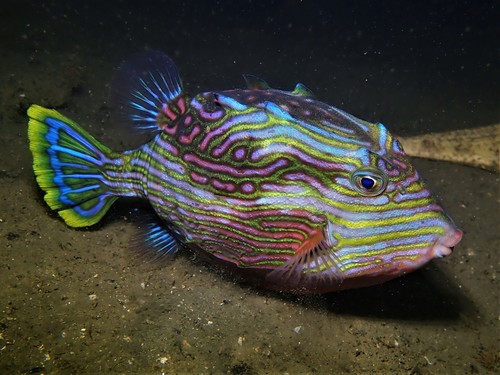
About Aracana aurita (Shaw, 1798)
Fin Ray Count
Aracana aurita has 10 or 11 soft rays in both its dorsal fin and anal fin, while both its pectoral fin and caudal fin have 11 or 12 soft rays.
Carapace Structure
The fish’s body is encircled by a stiff, boxy carapace formed of sculptured bony plates. Large recurved spines run along this carapace’s ridges.
Fin Placement
The dorsal and anal fins are positioned very far back on the body, and sit opposite one another.
Caudal Peduncle Plates
The bony plates covering the caudal peduncle are less developed than the main body carapace, but in adults these plates almost form a complete band around the structure.
Snout Contour
The contour lines of the snout are nearly horizontal.
Male Coloration
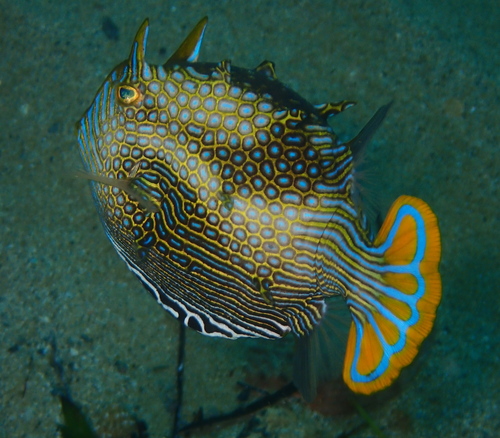
This species exhibits sexual dimorphism in coloration: males have bright coloration, with light blue wavy lines and spots over an orange base background.
Female and Juvenile Coloration
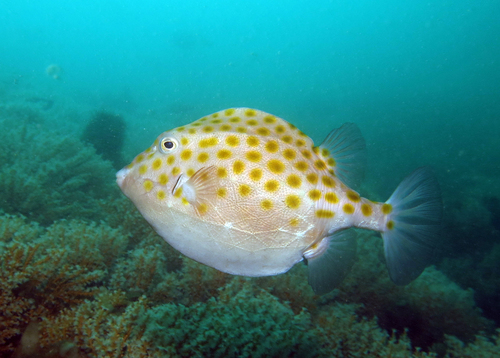
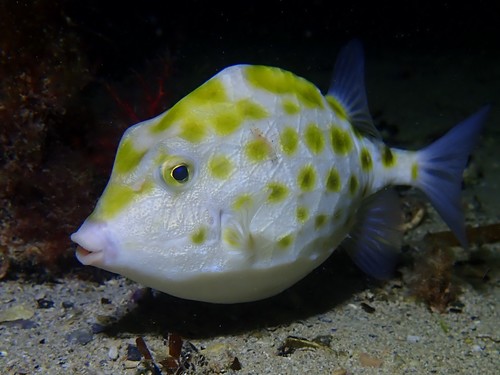
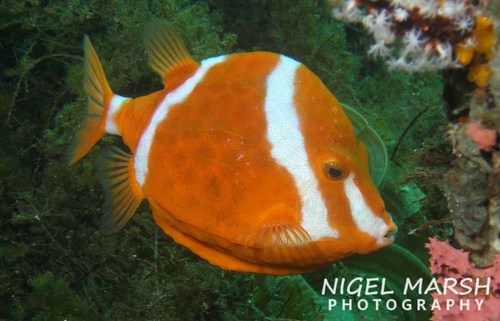
Females and juveniles have an overall base color ranging from light orange to light brown, marked with irregular brown and white sinuous lines or stripes.
Maximum Size
The maximum published total length for this species is 20 cm (7.9 in).
Geographic Range
Aracana aurita is endemic to southern Australia, with a range extending from Newcastle, New South Wales, south to Tasmania, and west to Kalbarri, Western Australia.
Habitat and Depth
It inhabits seagrass beds and offshore rocky reefs in sheltered waters of bays, harbours, and inlets, found at depths between 10 and 160 m (33 and 525 ft).