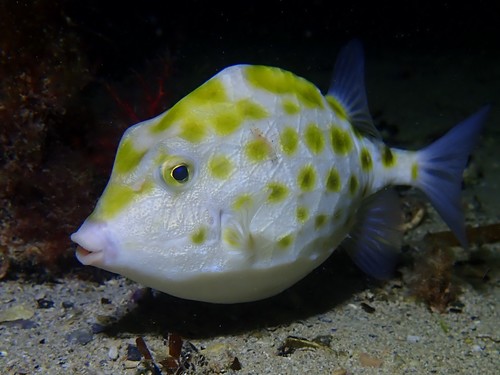
About Anoplocapros amygdaloides Fraser-Brunner, 1941
Taxonomy and Common Name
Anoplocapros amygdaloides Fraser-Brunner, 1941, commonly called the Western smooth boxfish, has 10 soft dorsal fin rays, 9 or 10 soft anal fin rays, 12 soft pectoral fin rays, and 11 soft caudal fin rays.
Dorsal Profile
The dorsal profile from the snout to the start of the dorsal ridge is straight.
Caudal Peduncle Scales
Two series of bony plate-like scales form rings around the caudal peduncle: the front ring is broken, while the rear ring is complete. Both rings have rough, plate-like scales because the scales are covered in tubercles.
Base Body Coloration
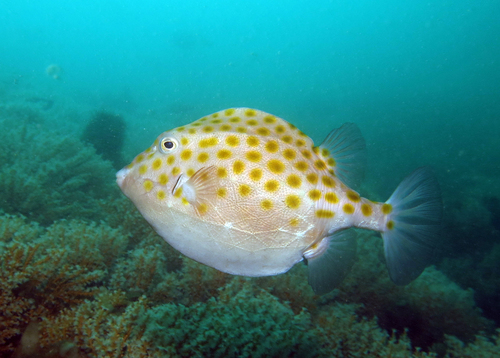
The base body color is yellowish-white, tinted brown above the lower ridge that runs along the flanks. The back and flanks are marked with a number of almost black spots, and the fins are translucent.
Mature Male Coloration
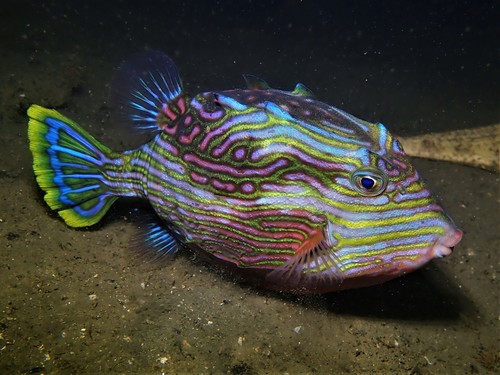
In larger males, the overall body color changes to bluish, which is paler on the ventral side; these males also have brown blotches, lines, and spots, and light blue fins.
Maximum Length
The maximum published total length for this species is 30 cm (12 in).
Geographic Distribution
This boxfish is endemic to southwestern Australia, ranging from the eastern Great Australian Bight in South Australia to Shark Bay in Western Australia.
Depth and Habitat
It lives at depths down to 100 m (330 ft), where it occurs on offshore reefs, in seagrass beds, and on trawling grounds.