About Aquilegia vulgaris L.
Taxonomic Classification
Aquilegia vulgaris L. is a perennial herbaceous flowering plant in the genus Aquilegia, family Ranunculaceae.
Rootstock Structure
This species has a thick, simple or branched rootstock, with one to two flowering stems that often grow upward from bushy clumps.
Stem Dimensions
Aerial stems reach 50–90 cm (20–35 in) in height, and measure 3–5 mm (0.12–0.20 in) wide at the base.
Stem Pubescence
They are leafy and usually covered in whitish pubescence (hairs), though some plants lack these hairs; stem branches are both glandular glabrous and pubescent, with more dense small whitish hairs on the upper portions than the lower.
Basal Leaf Dimensions
Basal leaves are abundant, reaching 22–40 cm (8.7–16 in) in total length including their 14–27 cm (5.5–11 in) petioles.
Basal Leaf Structure
These leaves are biternate, meaning each leaflet is further subdivided into three parts.
Basal Leaf Surface Features
The thin upper surface of basal leaf blades is glabrous, while the lower surface is glaucous (pale blue-grey) and pubescent.
Cauline Leaf Traits
Cauline leaves (leaves growing on aerial stems) are borne on 0.1–11 cm (0.039–4.3 in) petioles, appear singly or in pairs, and resemble basal leaves but grow smaller and simpler the higher they occur on the stem.
Flowering Periods
In its native range, wild A. vulgaris flowers from May to June; in naturalized North American populations, flowering runs from spring to summer, May to July.
Inflorescence Size
Inflorescences hold 3 to 18 flowers.
Bract Characteristics
Bracts are slightly glabrous or sparsely pubescent, downy on the lower side, and split into three lanceolate segments.
Peduncle Features
Peduncles are notably downy, densely covered in small hair-like trichomes.
Wild Flower Colors
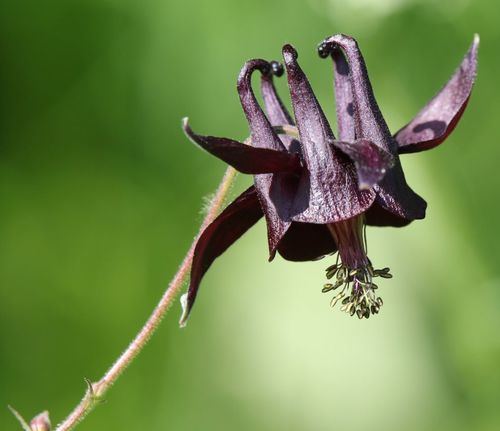
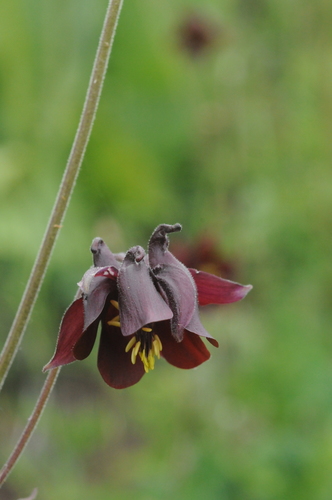
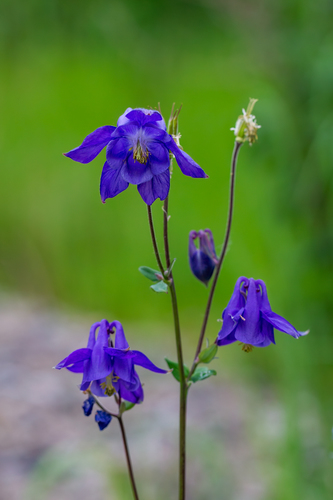
Wild plants, especially those classified as Aquilegia vulgaris subsp. vulgaris, typically have blue or purple flowers, with rare white or reddish variants.
Flower Morphology
Flowers are nodding (face downwards) and 30–60 mm (1.2–2.4 in) in diameter; primary flowers on an inflorescence are larger than secondary flowers, and overall are medium to small sized within the Aquilegia genus.
Sepal Traits
The five petaloid sepals may point outward or sit perpendicular to the flower’s central axis, and are ovate to ovate-lanceolate with sharp acute tips.
Sepal Dimensions
Sepals are shorter than petals, measuring 15–30 mm (0.59–1.2 in) long and 6–16 mm (0.24–0.63 in) wide.
Inner Flower Shape
The inner flower structure forms a cup shape.
Petal Spur Feature
Like other Aquilegia, A. vulgaris has five petals each bearing a nectar-producing nectar spur.
Petal Dimensions
Petals are medium-sized within the genus and isotropic, measuring 22–34 mm (0.87–1.3 in) in both length and width.
Petal Limb Traits
The broad flat limb (upper section) of the petal is shorter than the nectar spur; limbs have broad rounded ends, and are 10–14 mm (0.39–0.55 in) long by 8–13 mm (0.31–0.51 in) wide.
Nectar Spur Morphology
Nectar spurs are obconical, most often curved and rarely hooked, and range from 12–20 mm (0.47–0.79 in) long, with a 4–8 mm (0.16–0.31 in) wide throat that tapers evenly to the tip.
Stamen Dimensions
Each flower has multiple stamens 9–13 mm (0.35–0.51 in) long.
Fruit Characteristics
The fruits are follicles 15–25 mm (0.59–0.98 in) long.
Seed Traits
Like other Aquilegia, A. vulgaris produces large numbers of black seeds; A. vulgaris seeds have shiny surfaces, lack an elaiosome (the fleshy seed structure found on some species), measure 2.2–2.5 mm (0.087–0.098 in) long, and have a recorded average weight of 1.53 mg (0.0236 gr).
Chromosome Number
The chromosome number of this species is 2n=14.
Native Origin
Originally a European species, Aquilegia vulgaris likely originated in the Balkans, and is now the most widely distributed species in the Aquilegia genus.
Global Distribution Range
Its range expanded naturally and with human assistance, forming naturalized introduced populations in Africa, Macaronesia, the Americas, and Oceania, with established native populations in Asian regions including the Russian Far East and Uzbekistan.
Introduction Origin
Almost all introduced populations originate from ornamental cultivation.
Northern European Range
In Europe, the species ranges north to southern Scandinavia and England.
European Distribution Boundaries
It has been recognized as the only Aquilegia species in this northern region since the 19th century, making its northern distribution boundary clear, while its southern European distribution is less defined: its spread across the Iberian, Italian, and Balkan peninsulas has brought it into contact with other local columbine species, resulting in genetic introgression.
Eastern European Range
It ranges eastward into western Russia.
African Population
Aquilegia ballii, sometimes treated as a variety of A. vulgaris, grows in the Atlas Mountains and is the only Aquilegia found in Africa.
European Population Classification Debate
American botanist and gardener Robert Nold argued that classifying any European A. vulgaris populations as introduced rather than native is "tenuous at best", noting there is little evidence the species was absent from any part of Europe and its expansion is a natural process.
POWO Native Range Listing
The Royal Botanic Gardens, Kew's Plants of the World Online (POWO) lists A. vulgaris as native to Albania, Austria, the Balkans, the Baltic states, Belarus, Belgium, the British Isles, Bulgaria, Corsica, continental France, Germany, the Iberian and Italian peninsulas, the Low Countries, Poland, Sicily, Switzerland, and parts of European Russia; POWO classifies populations in Denmark, the Caucasus, Scandinavia, Ukraine, and parts of European Russia as introduced.
British Isles Arrival Hypotheses
Italian botanist Enio Nardi has investigated multiple hypotheses for how A. vulgaris reached the British Isles: the oldest arrival hypothesis suggests it spread across a land plateau connecting the British Isles to continental Europe during the Late Miocene, before 5.333 million years ago, while other hypotheses propose later arrival during the Quaternary glaciations, or even as recently as within recorded human history.
Macaronesia Distribution
A. vulgaris is an introduced species present in Macaronesia, the Atlantic archipelagos off the coasts of North Africa and Europe.
Macaronesia Occurrence Records
It has been repeatedly recorded on the Azores, Canary Islands, and Madeira since at least 1932, and has been documented on Tenerife (one of the Canary Islands) since at least 1974.
North American Naturalization
The species is naturalized in North America, where it escaped from ornamental cultivation and is established in cooler areas of the continent.
North American Population Origins
Most naturalized populations are the wild blue- or purple-flowered form, but others descend from horticultural forms with white, red, or pink flowers, and some North American populations are likely descendants of hybrids between A. vulgaris and other Aquilegia species.
North American Distribution
Naturalized populations occur on both the Pacific and Atlantic coasts of Canada and the United States; in the early 20th century, A. vulgaris was one of several foreign species proposed to be the national flower of the United States.
Oceania Distribution
In Oceania, the species has been introduced to the Australian states of New South Wales, Tasmania, and Victoria, and to both the North and South Islands of New Zealand.
South American Distribution
In South America, introduced populations have been recorded since at least 1845, when it was documented growing in Chilean cultivation, and populations have been recorded in both Chile and Argentina in the 21st century.
Aphid Pests
Aphids are known to attack columbines, especially A. vulgaris and its close hybrids.
Aphid Infestation Effects
Aphid infestations can cause stunted growth, sticky honeydew buildup on basal leaves, and deformed flowers or flowers that fail to open.
Pollination Mechanism
Pollination occurs when pollinators visit flowers to feed on nectar stored in the spurs.
Documented Pollinators
Long-term studies of European A. vulgaris populations have consistently documented visitation by bumblebees (Bombus), and hummingbirds have also been observed visiting cultivated specimens of the species.
Roman Cultivation Evidence
Archaeobotanical evidence indicates that A. vulgaris was cultivated as an ornamental plant in 3rd-century AD Roman Britain.
Roman Garden Evidence
Single A. vulgaris seeds found in burnt waste pits at Alcester and Leicester are interpreted as evidence of garden planting.
Medieval Cultivation Evidence
Columbine finds at a late Saxon site near Winchester Cathedral and three later medieval German sites are also interpreted as evidence of garden cultivation.
Medieval Religious Cultivation
In 12th-century Italy, people may have maintained A. vulgaris or Aquilegia atrata populations near religious structures, likely because columbines were treated as Christian symbols at the time.
16th Century Horticultural Records
Selectively bred horticultural forms of A. vulgaris were documented across Europe by the 16th century.
Linnaean Description Note
When Linnaeus formally described the species in 1753, he noted horticultural forms, which was a rare inclusion of cultivated plants in his work.
Modern Cultivation Status
Today, A. vulgaris is a commonly cultivated garden plant, though the wild form is rare in garden settings, and it is most often grown in one of its many selected cultivated forms (cultivars).
Historic Cultivar Popularity
Some of these cultivars were developed centuries ago and remain popular with gardeners in northern regions.
Cultivar Traits
Some cultivars have been bred for specific flower colors, while others are double-flowered, where stamens develop into petals or produce sepal-like perianths.
Cultivation Growing Conditions
The species grows well in sunny or partially shaded locations, and is suited to USDA hardiness zones 3 through 10.
Garden Lifespan
In garden settings, A. vulgaris plants typically live only three to four years, and can be described as having a biennial-like lifespan.
Seedling Production
In that time, each plant can produce dozens of seedlings.
Lifespan Extension Practice
Removing dead flowers before the plant expends energy on seed production, a practice called deadheading, can extend the lifespan of columbine plants.