About Aquilegia pyrenaica DC.
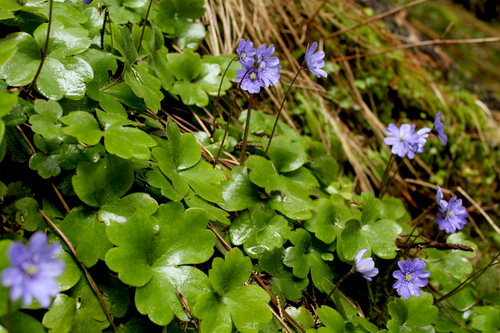
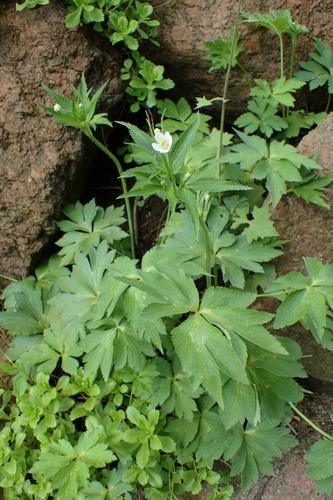
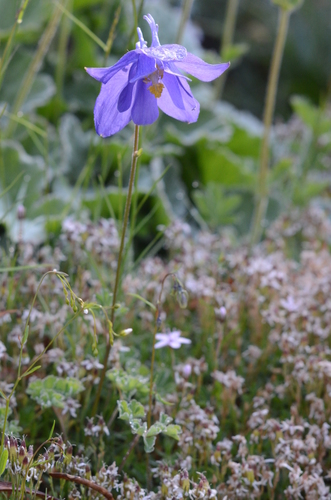
Aquilegia pyrenaica DC. reaches a height of 10 to 30 cm (4 to 12 in). It is closely related to the taller Aquilegia alpina. Its stem is usually simple and more or less glabrous. The leaves are bluish-green, trifoliate, with petioles that clasp the stem. The flowers measure 3 to 5 cm (1.2 to 2.0 in) across and 2.5 to 3.5 cm (1.0 to 1.4 in) long, and are bright blue or lilac. Technically, the blue spreading outer structures of the flower are sepals, while the paler blue inner structures are the true petals. The petals have spurs at the back of the flower; these spurs contain nectar that attracts the plant's pollinators. In this species, the spurs are long, slender, and only very slightly curved. The stamens are yellow and protruding, and the carpels are not fused together. This plant blooms from April to June. This species prefers pastures and rocky places growing at an altitude of 1,000 to 1,600 metres (3,300 to 5,200 ft). It is native to France and the Pyrenees. It was introduced into cultivation in Britain in 1818. In 1895, it was planted on rock ledges in Caenlochan Glen, Angus, Scotland, where it became naturalised. It also appeared as a casual arrival at Doncaster Sheffield Airport in 1986.