About Aquilegia parviflora Ledeb.
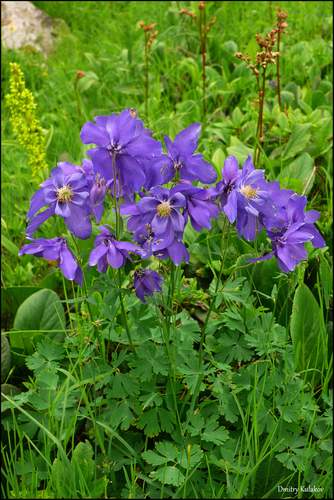
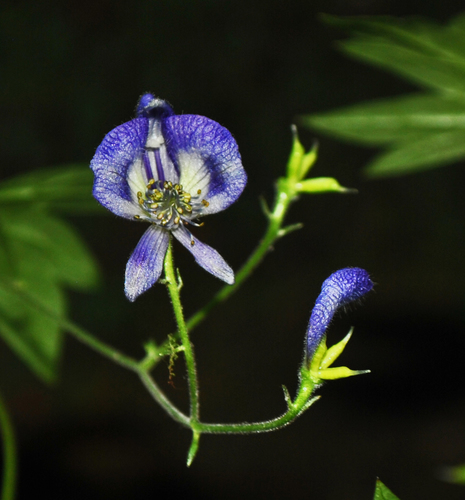
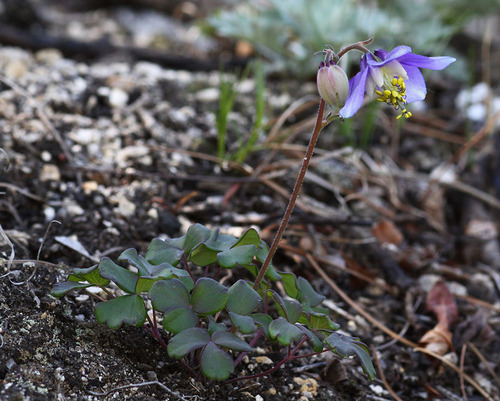
Aquilegia parviflora Ledeb. typically grows around 40 centimetres (16 inches) tall, with an observed height range from 10 centimetres (3.9 inches) to 80 centimetres (31 inches). Its stems are between 1 millimetre (0.039 inches) and 2 millimetres (0.079 inches) thick, glabrous, and plants may produce multiple branched stems. This species has a small number of leathery leaves that grow in a basal arrangement from the base of the stems. Flowering occurs for two to three weeks in mid-spring (June). Plants produce many small flowers, each measuring 2.5 centimetres (0.98 inches) to 3.5 centimetres (1.4 inches) across. Its blue-purple sepals are 15 millimetres (0.59 inches) to 20 millimetres (0.79 inches) long, spreading, and ovate or oblong-ovate in shape. Petal blades can be blue-purple or white, and measure 3 millimetres (0.12 inches) to 5 millimetres (0.20 inches) long. Stamens range from 8 millimetres (0.31 inches) to 11 millimetres (0.43 inches) long. Compared to other Aquilegia species, the nectar spurs of Aquilegia parviflora are short and strongly curved, reaching only 3 millimetres (0.12 inches) to 5 millimetres (0.20 inches) in length. Spurless individuals of this species have been observed. Fruiting takes place one month after flowering, and the seeds are 2 millimetres (0.079 inches) long. Aquilegia parviflora is native to northern Asia, occurring in Siberia, northern Mongolia, and northern China. In Russia, it has been recorded in Amur Oblast, the former Chita Oblast (now part of Zabaykalsky Krai), Irkutsk Oblast, Khabarovsk Krai, Krasnoyarsk Krai, Magadan Oblast, Primorsky Krai, Sakha Republic, and Sakhalin Island. In China, it is found in Inner Mongolia and Manchuria, and the 2001 Flora of China reported the species is also present in Japan. It grows in woodlands, slopes, forest clearings, and meadows within its native range, at elevations between 2,500 metres (8,200 feet) and 3,500 metres (11,500 feet). In 1901, A. K. Cajander, a botanist who later became Prime Minister of Finland, traveled along the lower Lena River in Siberia and collected four specimens of Aquilegia parviflora among vascular plant specimens he gathered. Cajander's notes recorded the species occurring from the mouth of the Vilyuy, a tributary of the Lena, into subalpine zones, where its frequency was described as fairly frequent to very frequent. He noted its abundance decreases north of the Vilyuy's mouth, disappearing completely halfway between the Vilyuy and Agrafena. He found the species growing in larch forests and on forest margins, noting it prefers half-open places. Cajander described Aquilegia parviflora as one of the most characteristic plants of the taiga along the Middle Lena, and stated it never grows in alluvial plains. Because gardeners generally prefer columbine species with larger flowers, Aquilegia parviflora is usually only cultivated by specialty collectors. In 1946, botanist Philip A. Munz recorded that this species did not appear to be in cultivation in the United States. For cultivation, it should be planted in sunny or semi-shaded locations. Russian botanist Tatyana Shulkina noted that this plant is well-suited for growing in rock gardens.