About Aquilegia micrantha Eastw.
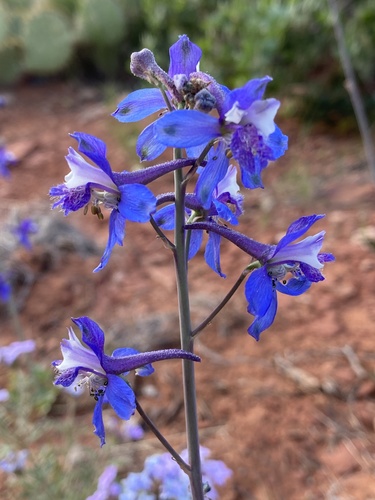
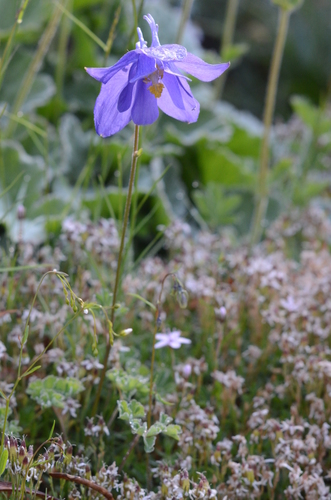
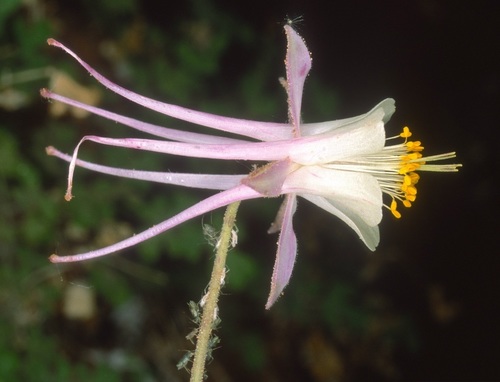
Aquilegia micrantha Eastw. is a perennial herb that belongs to the columbine genus Aquilegia in the buttercup family Ranunculaceae. This species shows considerable natural variation. Its stems reach 30 to 60 cm (12 to 24 inches) in height, and measure 1 to 3 mm (0.039 to 0.12 inches) in thickness. Basal leaves growing from the base of the stem are bi- or triternately compound. Both stems and leaves may be lightly hairy. All Aquilegia flowers have five sepals and five petals, and all Aquilegia flowers are bisexual. In wild populations, A. micrantha blooms from spring through summer, between April and September. Its flowers are either nodding or erect, and their sepals can be white, cream, blue, or pink. American botanist Philip A. Munz also recorded observations of reddish sepals in the species. Sepals are 8 to 20 mm (0.31 to 0.79 inches) long. The flower blades are white or cream, and 6 to 10 mm (0.24 to 0.39 inches) long. Stamens extend 3 to 5 mm (0.12 to 0.20 inches) beyond the blades. Nectar spurs are 15 to 30 mm (0.59 to 1.2 inches) long, straight, with inward-curving tips; spurs are either white or match the color of the sepals. A spurless variety of this species, Aquilegia micrantha var. mancosana, has been documented. Fruiting across the Aquilegia genus produces cylindrical follicles; on A. micrantha, these follicles measure 10 to 20 mm (0.39 to 0.79 inches) long. The species produces seeds that are 1 mm (0.039 inches) long. Aquilegia micrantha is endemic to the Southwestern United States, where it occurs in southeastern Utah, southwestern Colorado, and extreme northern Arizona. It grows exclusively on hanging gardens in the canyons of the Colorado Plateau and Canyonlands, where alkaline water seeps from cliff bases. It grows most commonly at elevations between 1,000 m (3,300 ft) and 2,500 m (8,200 ft), which falls within the juniper belt ecological zone. Because Aquilegia species have no genetic barriers to hybridization, they hybridize wherever overlapping ranges occur; A. micrantha hybridizes with A. elegantula at the eastern edge of its range. A 1983 study of pollination in A. micrantha in upper Crystal River Canyon, Colorado identified several species that act as pollinators. The most effective pollinators observed were bumblebee queens of Bombus appositus and Bombus flavifrons, which visited the plants to collect nectar. Hummingbirds and hawkmoths also visited A. micrantha, and hummingbirds are the most important pollinators of the species at other study sites. The study hypothesized that the low frequency of bumblebee visits to red-flowered Aquilegia elegantula acted as a mechanism to reduce hybridization between A. elegantula and A. micrantha. Aquilegia micrantha has been used by the Navajo and Kayenta peoples to aid in childbirth.