About Aquilegia coerulea James
Aquilegia coerulea James, commonly known as Colorado columbine or Rocky Mountain columbine, is a perennial herbaceous plant that regrows from a simple or branched caudax covered in old petiole bases, the stems that support individual leaves. Fully grown flowering stems reach 15 to 80 centimeters (6 to 31 inches) in height. Basal leaves, which grow from the base of the plant, are always shorter than flowering stems, measuring just 9 to 37 cm (4 to 15 inches) tall. These are compound leaves, usually biternate with a total of nine leaflets arranged in groups of three. Occasionally, leaves may be simple (trifoliate with only three leaflets) or more complex (tripinnate). Each leaflet is thin and marked with three lobes. The upper leaflet surface is green and glabrous (smooth and hairless), while the underside may be either glabrous or pubescent (covered in fine, minute hairs). Most leaflets range from 13 to 42 mm (1⁄2 to 1+5⁄8 inches) in size, but may occasionally grow as long as 61 mm (2+3⁄8 inches).
In the wild, blooming can start as early as late April and continue as late as early September, though plants usually do not bloom earlier than May. Mature plants produce one to ten flowering stems, with an average of three to four, and each stem holds three to four flowers. Flowers open sequentially, starting with those furthest out on the stem and moving downward. Flower buds nod, facing somewhat downward. The flowers are large and showy, reaching up to 15 centimeters (6 inches) in diameter, and most often measure 5 to 10 cm (2 to 4 inches) across. Botanists E. O. Wooton and Paul C. Standley wrote enthusiastically of this species in their 1915 *Flora of New Mexico*, noting, "This is the State flower of Colorado and no other State has one so beautiful. Few indeed are the flowers of the Rockies that can compare with this in beauty. The great blossoms, sometimes six inches in diameter, look like bits of fallen sky, and when the plants cover acres of meadow, as they sometimes do, no words can be found to do them justice."
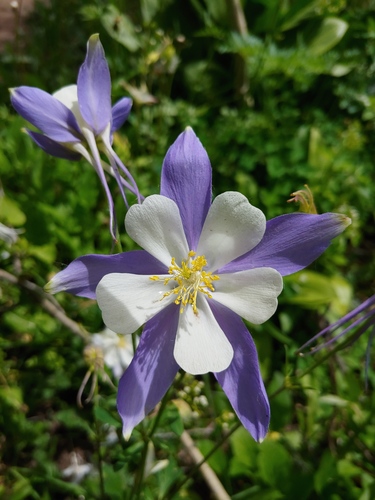
Flowers are held atop erect stems that stand perpendicular to the ground, and have five large, spreading sepals that resemble petals, ranging in color from white to deep blue, and occasionally pink in wild populations. Sepal shapes range from elliptic-ovate (a flattened circle with somewhat pointed ends, widest toward the base) to lance-ovate (somewhat egg-shaped spear head), and measure 26 to 51 millimeters long by 8 to 23 millimeters wide. The five petals have very long tapered spurs that range from 25 to 72 millimeters in length, and are usually longer than 34 mm. The petal blades are 13 to 28 mm long by 5 to 14 mm wide. Petals are most often white to cream at the front, while their spurs share the same range of colors as the sepals. The flowers are scented, and produce more scented volatile molecules during the day than in the evening. The center of the flower has a projecting cluster of numerous bright orange-yellow stamens, with a total of 50 to 130 stamens per flower. The flowers are protandrous, meaning they develop pollen before the stigma becomes receptive. Stamens range from 13 to 24 mm in length, and surround three to ten unfused carpels; most flowers have six carpels, though this number can vary even on the same plant. If fertilized, each carpel may develop into a follicle, a dry pod that splits along one side. Each pod is round in cross section and filled with small, smooth, black seeds. Both the number of pods that develop and the number of seeds per pod decrease for flowers that bloom later on a single plant.
The leaves of Aquilegia coerulea may be mistaken for those of meadowrue (Thalictrum), but the flowers are entirely different, so the species cannot be confused when in bloom. Similar columbines found within its range include Aquilegia scopulorum, Aquilegia jonesii, and Aquilegia micrantha. Aquilegia scopulorum has leaves covered in natural waxes that give them a blue-green (glaucous) color rather than green, and is native to Nevada and Utah. Aquilegia jonesii has much shorter flower spurs, measuring only 8 to 15 mm, and grows further north in Wyoming, Montana, and Alberta. Aquilegia micrantha has viscid, very sticky leaves.
Colorado columbine is native to the Rocky Mountains, ranging from northern New Mexico to southern Montana. It grows throughout all mountainous areas of the western half of Colorado and Wyoming, as well as in every county of Utah, parts of Nevada, and northern Arizona. The USDA lists it as growing in Idaho and South Dakota, but does not provide county-level distribution for these areas. The species was reported growing in Caribou–Targhee National Forest in eastern Idaho in 1973. While the geographic center of its range is in eastern Utah, the highest number of individual plants is found in the mountains of north central Colorado. Rocky Mountain columbine grows in mountainous areas, starting at lower elevations alongside the Rocky Mountain variety of Douglas-fir. It becomes more common at higher elevations in montane ecosystems and subalpine habitats, and some individuals grow above the timberline in alpine tundra. The lowest natural elevation for the species is 1,800 meters (5,900 ft) for Aquilegia coerulea var. pinetorum, and the highest is 3,600 meters (11,800 ft) for Aquilegia coerulea var. coerulea in the southern Rocky Mountains. This columbine species grows poorly in heavy soils without good drainage, but prefers moist areas and is very often found in quaking aspen groves. It also grows in open coniferous forests, meadows, and clearings. When sufficient water is available, it will thrive on rocky outcrops and slopes.
Within its natural range, Aquilegia coerulea is most often pollinated by hawkmoths and bumblebees. Recorded hawkmoth species include Hyles lineata and Sphinx vashti. Recorded bumblebees include Bombus appositus, though Bombus flavifrons visits flowers much more frequently. Hawkmoths usually visit at night, while bumblebees only visit during daylight hours. Plants have the highest rate of cross-fertilization between individuals in areas with fewer flowers and higher hawkmoth populations. Generally, only hawkmoths with their very long tongues can reach the nectar at the bottom of the very long spurs, while bumblebees visit primarily or only to collect pollen. The western bumblebee (Bombus occidentalis) has been observed nectar robbing from Aquilegia coerulea by opening or using pre-existing holes cut in the spurs; prior to its population decline in the 21st century, it was also a significant pollinator of the species in some areas. The broad-tailed hummingbird also visits the blooms, but at a much lower rate than moths or bees.
Aquilegia coerulea is grown as an ornamental plant in gardens. It was adopted as a garden plant very soon after its formal scientific description, and was introduced to the United Kingdom in 1864. It is also planted in American gardens for its ability to attract hummingbirds, and is tolerant of damage from deer and rabbits. The Federal Highway Administration's Office of Natural Environment recommends it as an attractive plant for revegetation of mountain roadsides within its native range; when planting large areas, it is seeded at a rate of 112 ounces per acre. Colorado columbine is winter hardy in USDA zones 3 to 8. Cultivated plants grow most successfully in average to medium well-drained garden soil with consistent moisture. They can be grown in full sun or partial shade, but grow best in light to moderate shade. They are propagated both by seed and by plant division.
Colorado columbine is vulnerable to powdery mildews, particularly when its leaves are regularly wetted by overhead irrigation. It is also susceptible to aphid infestation, though no more so than other columbine species. Plants may also be attacked by leaf-miner flies and sawflies. Treating seeds with gibberellic acid and planting at 21 °C (70 °F) results in 93% germination after three weeks. Untreated seeds do not germinate readily; no seeds sprout when planted at 21 °C without treatment, while 40% germination occurs after two weeks when seeds are first cold stratified at 4.5 °C (40 °F). In gardens, plants usually live a maximum of three or four years, and are often grown by gardeners as if they were biennials. The species' natural variability and ease of hybridization with other columbines has been exploited to select numerous cultivars in different colors. This is a drawback for gardeners seeking the standard blue and white columbine flowers, as they often need to source collected seeds instead of replanting their own. Cultivars that are probably entirely or largely derived from Rocky Mountain columbine include 'Alba', 'Albiflora', and 'Snow Queen'. Cultivars thought to have significant A. coerulea ancestry include 'Crimson Star' and 'Rose Queen'. The 'Origami' series of hybrids, such as 'Origami Blue', 'Origami White', and 'Origami Yellow', are listed by authors P. Allen Smith and Allan Armitage as being largely derived from A. coerulea, but plant sellers will sometimes list them as Aquilegia vulgaris. The 'Origami' hybrids were originally developed by Goldsmith Seeds. The genome of the 'Goldsmith' cultivar was sequenced as part of a study of gene transfer between columbine species, and was later used to study the evolution of basal eudicots.