About Aquilegia brevistyla Hook.
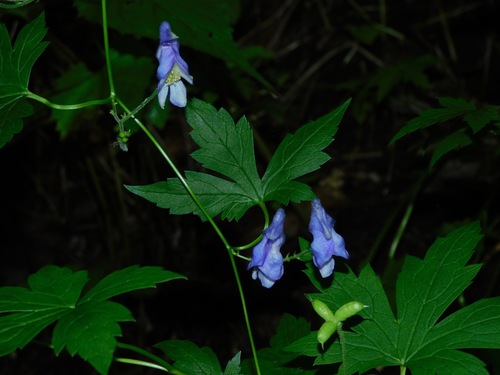
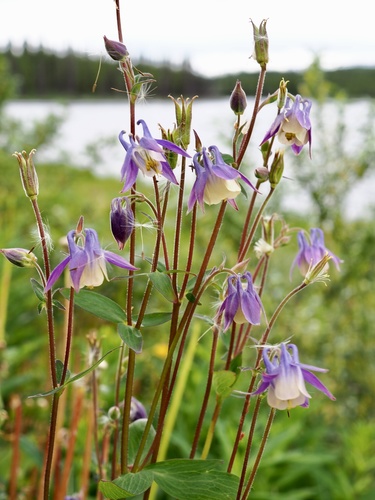
Aquilegia brevistyla Hook. is a species of flowering plant in the buttercup family, commonly called smallflower columbine. It is native to northern North America, where it has a disjunct distribution. Most of its range extends from Alaska through much of Canada, and it also grows in a few areas of the contiguous United States, including the Black Hills of South Dakota and central Montana. It is most abundant in eastern Alaska, Yukon, the southern Northwest Territories, and the northern portions of Alberta, Manitoba, and Saskatchewan. This species is a rhizomatous perennial herb that produces stems up to 80 centimeters tall. Its leaves are compound, divided into leaflets with wavy edges. Basal leaves grow on long petioles, while leaves positioned higher on the stem have much shorter petioles. The nodding flowers are small for a columbine species. The sepals are up to 2.5 centimeters long, reflexed, and range in color from blue to lavender. The spurs are up to one centimeter long. The petals are white or light yellow and also reach up to one centimeter in length. The fruits are follicles that grow up to 2.5 centimeters long. Its flowering period runs from May through July or August. This plant is most often found in moist habitat types, but it can also grow in drier areas. It is frequently associated with limestone and other calcareous substrates, but it may also grow on granite soils. It inhabits coniferous forests, open woods, meadows, and riverbanks. In the northern portion of its range, it typically grows in coniferous forest habitat. In the Black Hills area, it can be found growing alongside Picea glauca, Pinus ponderosa, and Populus tremuloides. It usually grows in forest understory, but it may occasionally be found in more open habitats. It is often associated with various mosses, including the feather moss Hylocomium splendens, and it may grow within moss carpets. In parts of its range, even remote areas, this plant is threatened by habitat loss. Some southern populations of the species are threatened by recreational activities, particularly off-road vehicle use. Grazing is also a threat to the species in some areas.