About Apteryx owenii Gould, 1847
Scientific Naming and Taxonomy
The little spotted kiwi, scientifically named Apteryx owenii Gould, 1847, is the smallest species of kiwi.
Body Size and Mass
Adults measure 35 to 45 cm (14–18 in) in length; males weigh 0.88 to 1.36 kg (1 lb 15 oz – 3 lb 0 oz), while females weigh 1 to 1.95 kg (2+1⁄4–4+1⁄4 lb).
Feather Characteristics
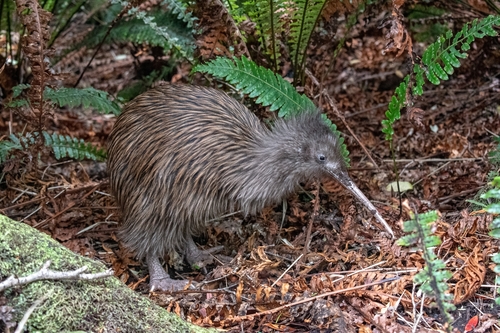
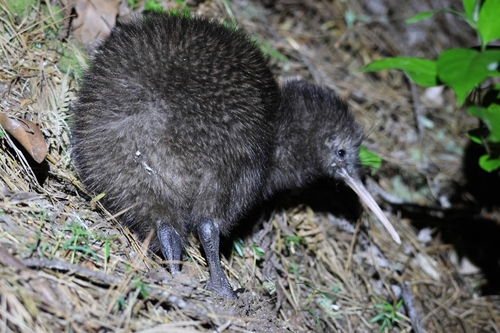
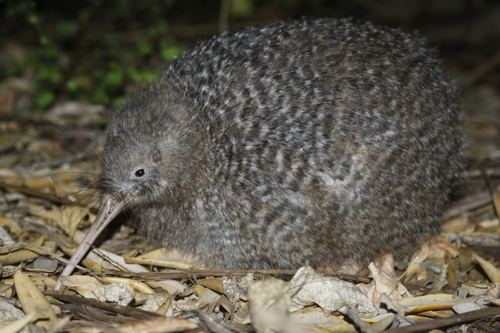
Their shaggy feathers are pale mottled grey with fine white mottling, and they lack aftershafts and barbules. They have large vibrissae feathers around the gape.
Tail Structure
Though they have no tail, they do have a small pygostyle.
Bill and Leg Coloration
Their long bill is ivory-coloured, and their legs are pale.
Parasite Species
An obligate louse, Rallicola pilgrimi, parasitised specifically on little spotted kiwi.
Conservation-Induced Extinction
When the kiwi were translocated to Kapiti Island for conservation, all of these lice were killed, which is an example of conservation-induced extinction.
Preferred Habitat Types
Studies of little spotted kiwi on Kapiti Island show that the species prefers flax, seral, and older forest habitats.
Habitat Suitability and Territoriality
Lower population numbers are found in rough grassland and scrub; this suggests either the species prefers other habitat types, or that individuals need larger territories to support themselves in these open areas.
Nesting Behavior
For reproduction, little spotted kiwi nest in excavated burrows, which are dug by both members of a breeding pair, and are sometimes lined with plant material.
Egg Laying Period
Females lay eggs between July and January.
Clutch Size
Clutch size is one to two eggs, with 15% of clutches containing two eggs.
Incubation Period
The male incubates the eggs for 63 to 76 days.
Post-Hatching Development
After hatching, chicks remain in the nest for 2 to 3 weeks, and require feeding for 4 weeks.
Egg-to-Body Weight Ratio
A little spotted kiwi egg weighs approximately 23% of the parent bird’s body weight.
Comparative Egg Size
This is the largest egg-to-body-weight ratio among kiwi, and among birds in general, though it is exceeded by some marine birds such as the Guadalupe murrelet and storm petrel.