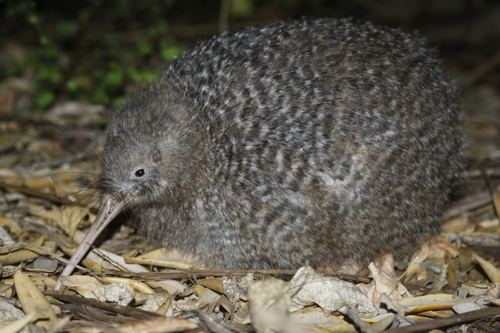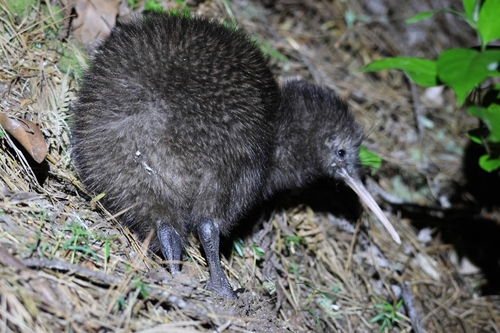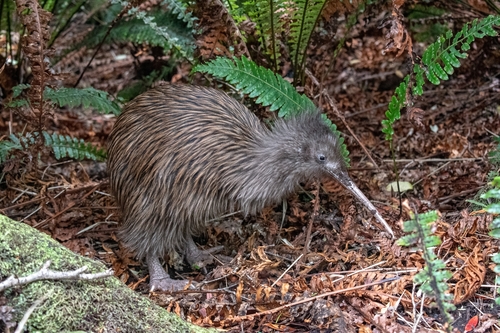
About Apteryx australis Shaw, 1813
Gland and Feather Morphology
This species lacks a preen gland. Its feathers have no aftershafts and no barbules.
Facial and Skeletal Features
Large vibrissae are present around its gape, and it has no tail, with only a pygostyle present.
Size and Weight
It reaches a total length of 45 to 55 cm (18–22 in); females weigh 2.1 to 3.9 kg (4.6–8.6 lb), while males weigh 1.6 to 2.8 kg (3.5–6.2 lb).
Bill Structure
Its bill is long and slender, with a slight downward curve.
Activity Pattern
Like other kiwis, this species is nocturnal.
Plumage Coloration
Its plumage is rufous in color with some streaking.
Overall Distribution
Southern brown kiwi (Apteryx australis) inhabit the South Island and Stewart Island of New Zealand.
South Island Range
On the South Island mainland, they are found in Fiordland and Westland.
General Habitat Preferences
They occupy temperate and sub-tropical forests, grassland, and shrubland, preferring denser vegetation.
Stewart Island Habitat
They are widespread across Stewart Island, where they also live on sand dunes.
Reproductive Anatomy
Like all kiwi, the southern brown kiwi has two functioning ovaries, but only the left oviduct is functional, which lets eggs from both ovaries pass through.
Mating System
It is a monogamous species.
Territorial Defense
Once paired, the couple defends their territory using warning calls.
Territory Size
Their territories range in size from 4.9 to 43 hectares (12 to 106 acres).
Nesting Sites
Nests are built in burrows, or in sheltered spots under thick vegetation.
Egg Laying and Incubation
The female lays 1 to 2 eggs, most often just one egg, which the male incubates for 90 days.
Chick Development
A few days after hatching, the chick will leave the nest to feed on its own, though it may remain near its parents for up to a year.
Adult Roosting Behavior
When not incubating eggs, adult southern brown kiwi roost alone in sheltered spots at ground level.