About Apodichthys flavidus Girard, 1854
Common Name and Color Variation
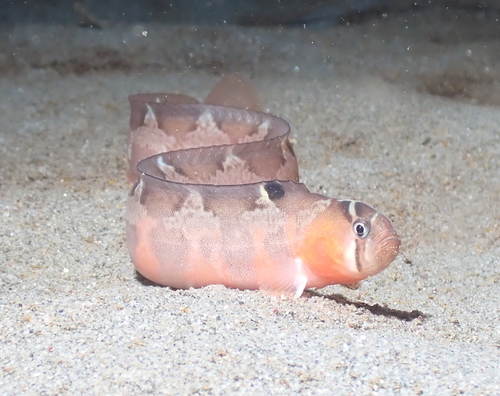
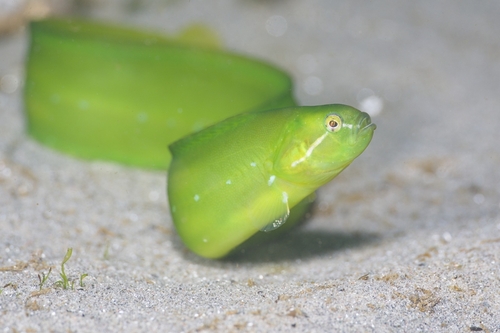
Apodichthys flavidus, commonly called the penpoint gunnel, varies in coloration, with individuals ranging in color from green to maroon or brown.
Maximum Length
This species reaches a maximum published total length of up to 46 centimeters (18 inches).
Distinctive Facial Marking
It is most easily identified by the dark bar located below each eye, a feature often visible when the fish peeks out from a kelp bed or crevice.
Body and Dorsal Fin Markings
A row of dark and/or pale spots runs along its midbody, and there is commonly a series of short, pale bar-shaped markings that extend downward from the top of its dorsal fin.
Anal Fin Spine Morphology
The first spine of its anal fin is large and grooved, shaped like the point of a fountain pen.
Fin Presence and Absence
It has continuous dorsal, caudal (tail), and anal fins, but lacks ventral fins.
Caudal Fin Trait
The tail fin is distinguished by slightly longer fin rays.
Anal Fin Length
The anal fin is approximately half the length of the dorsal fin.
Body and Fin General Shape
This is an elongated fish, with long-based, low dorsal and anal fins.
Fin Ray and Spine Counts
The dorsal fin contains between 40 and 44 spines, while the anal fin has one spine and between 38 and 42 soft rays.
Caudal and Pectoral Fin Shape
The caudal fin is rounded, and the pectoral fins are small and rounded.
Depth Range
The penpoint gunnel is found mainly in intertidal habitats at depths between 0 and 1.8 meters (0.0 to 5.9 feet).
Geographic Distribution
Geographically, its distribution extends along the Pacific coast of North America, from Kodiak Island in the Gulf of Alaska to Santa Barbara Island in southern California.
Vegetated Habitat Types
It can sometimes be observed in tide pools, as well as in eelgrass beds, sea lettuce beds, and kelp stands.
Habitat Camouflage
It commonly matches the color of the vegetation it inhabits.
Rocky Habitat Use
When no vegetation is available, for example during winter, it can also occupy rocky areas, hiding under rocks and within protective crevices.
Air Breathing Ability
It can even stay out of water beneath rocks or seaweed, and is able to breathe air while out of water.