About Castilleja linariifolia Benth.
Species Nomenclature
Castilleja linariifolia Benth., commonly called Wyoming paintbrush, is a perennial herb.
Plant Height
It typically grows 18 to 100 centimeters (7–39 inches) tall, and may occasionally reach 2 meters (6+1⁄2 feet) in height, and is usually taller than other paintbrush species.
Stem Growth Habit
A few to several stems grow upright or slightly leaning from the plant's crown, and usually branch near the top.
Lower Stem Pubescence
Lower stem portions are either hairless or puberulent, covered in very short, thin hairs that usually stand straight out from the stem surface.
Upper Stem Pubescence
Near the flowering tips, stems are sometimes hairless, but more often covered in hispid (bristly) to villous (long, soft, non-matted) hairs; all hairs on the plant are non-glandular.
Underground Structure
Underground, the species has a woody caudex that sits atop a single or branched taproot.
Leaf Coloration
Wyoming paintbrush leaves are most often gray-green to moderately yellow, and may sometimes be distinctly purple.
Leaf Length
Leaves measure 1 to 10 centimeters long, and are rarely shorter than 2 centimeters.
Leaf Lobing Prevalence
Most leaves have smooth, unlobed edges, but upper leaves may sometimes develop pairs of narrow side lobes; very rarely, all leaves on a plant will have lobes.
Leaf Lobing Characteristics
When lobes are present, most plants develop just one pair of side lobes, though very rarely two pairs occur, for a total of five lobes including the leaf tip, and these lobes spread widely.
Leaf Shape
Leaves are usually narrow and grass-like or even thread-like, but may occasionally take a narrow lanceolate shape.
Leaf Pubescence
Like stems, leaves are usually hairless, but may sometimes be hairy.
Leaf Texture
Leaves are not fleshy overall, though they may be slightly thickened or have inward-rolling fleshy edges.
Inflorescence Dimensions
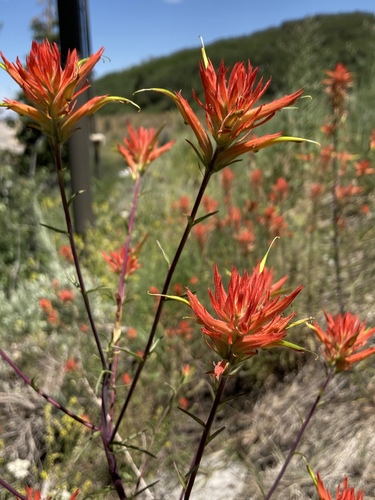
The upper 4 to 20 centimeters (1.5–8 inches) of the stem forms an inflorescence 2 to 7.5 centimeters (1–3 inches) in diameter.
Inflorescence Structure
The inflorescence is a spicate raceme, with individual flowers attached directly to the main stem without small stalks, and flowers are more widely spaced toward the lower portion of the inflorescence.
Notable Botanical Description
Botanist Francis Marion Ownbey described this species as the most spectacular Castilleja species in the Pacific Northwest in his work Vascular plants of the Pacific Northwest, due to its striking blooms.
Flower Covering Structures
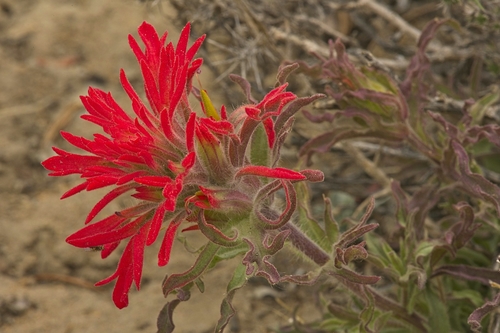
Flowers are partially hidden by colorful fused sepals (called calyces) and bracts.
Bract Color Variation
Bracts are normally solid red to red-orange, but color variants including pale green, yellow, magenta, pink-purple, or white all occur.
Bract Basal Coloration
Bracts may also be pale green or pale yellow near their base, with any of the variant colors on the rest of the structure.
Bract Lobing
Each bract usually has one or two pairs of side lobes that either spread outward or point upward together.
Calyx Length
Calyces are generally longer than the bracts, typically 1.8 to 3 centimeters long, and very rarely reach 3.5 centimeters.
Calyx Coloration
Calyx bases are greenish, whitish, or yellowish, and match the bract color in the upper portion.
Calyx Incisions
The calyx has a front incision that reaches about 70% of the total calyx length, and a back incision that reaches 20 to 25% of the total length.
Corolla Characteristics
The internal corolla is tubular and beak-shaped, 2.5 to 4.5 centimeters long, usually slightly curved, and yellow-green or green in color.
Bloom Period
Across its native range, blooming can occur as early as April and as late as October.
Fruit Characteristics
Fruits are capsules 9 to 13 millimeters long.
Species Distinction From Congener
Wyoming paintbrush can be distinguished from giant red paintbrush (Castilleja miniata) by its 1.2 to 2.2 centimeter long front incision on the partially fused sepals.
US Native Range
Wyoming paintbrush is native to every western US state from the Rocky Mountains to the Pacific coast, with the exception of Washington state.
Mexico Native Range
It is also native only to the state of Sonora in northwestern Mexico.
Wyoming Distribution
In Wyoming, it occurs across most of the state, and is only absent from eight of the state's 23 counties, six of which are in eastern Wyoming.
Montana Distribution
In Montana to the north, it grows in eight counties, ranging from Big Horn County in the south to Missoula County in the west.
Idaho Distribution
In Idaho, it occurs mainly in the southern part of the state, but is also found in some northern counties including Bonner County near the border in the Idaho panhandle.
Oregon Distribution
Its range in Oregon covers the southeastern half of the state.
California Distribution
In California, Wyoming paintbrush grows in the Cascade Range, high Sierra Nevada, Transverse Ranges, and eastward into the Mojave Desert and Modoc Plateau.
Nevada Utah Distribution
In Nevada and Utah, it has been recorded in every county of both states.
Colorado Distribution
In Colorado, it occurs across the entire western half of the state, and is absent from all counties in the shortgrass prairie region.
Elevation Range
It grows at elevations ranging from 600 meters (2,000 feet) to 3,400 meters (11,200 feet).
General Habitat Types
The species grows in associated habitats including sagebrush steppe, grasslands, and pinyon–juniper woodlands.
Specific Substrate Habitat
It often grows on dry rocky slopes, dry plains, cliff-base talus deposits, and in forest openings.
Associated Lepidoptera Herbivory
In some areas including Gunnison County, Colorado, the Edith's checkerspot butterfly (Euphydryas editha) feeds nearly exclusively on Wyoming paintbrush.
Herbivory Preference Rationale
While other local species such as desert paintbrush (Castilleja chromosa) and Rocky Mountain penstemon (Penstemon strictus) have similar nutritional content, Wyoming paintbrush's greater and more consistent availability even during droughts is thought to have led the butterfly to prefer this species.