About Aphanius fasciatus (Valenciennes, 1821)
Body Shape
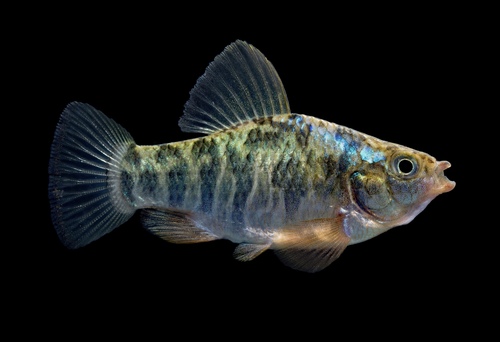
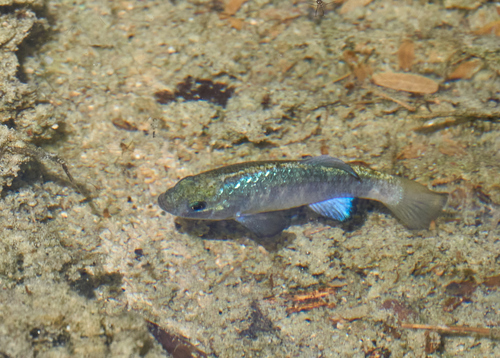
The Mediterranean killifish, Aphanius fasciatus, has an elongated body that is slightly flattened along the sides. Its head is flattened on the top, and bears large eyes and an upper mouth covered in small, three-pointed teeth.
Scales
There are 25 to 30 large scales arranged in a longitudinal row along the body, and the head is also covered in scales.
Pectoral and Ventral Fins
The pectoral fins sit below the midpoint of the body, while the ventral fins are positioned on the abdomen.
Dorsal and Anal Fins
The dorsal fin, which has 10 to 13 rays, is located quite far back on the body, just in front of the anal fin that has 9 to 12 rays.
Caudal Fin
The caudal fin is not forked and ends in a rounded shape. All fins of the Mediterranean killifish consist only of soft rays.
Sexual Coloration Dimorphism
Like many toothcarps, the coloration of this species varies strongly between sexes.
Male Coloration
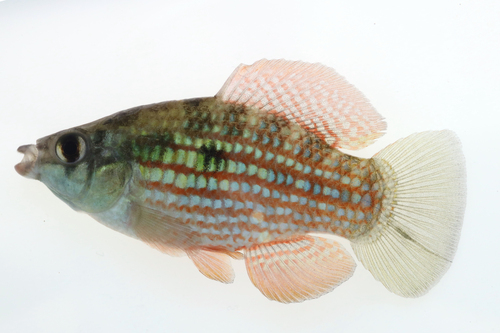
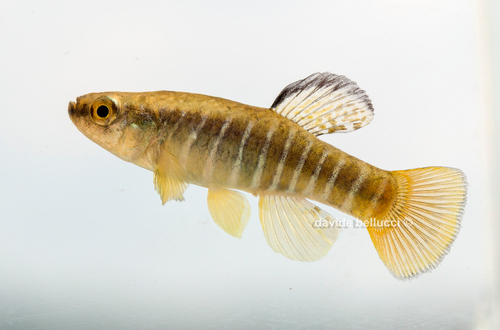
Males have an olive-green-bluish color on the back and flanks, a light belly with a silvery sheen, and 10 to 15 broad, dark transverse bands across the flanks. Their fins are yellowish.
Female Coloration
Females have much more subdued coloration: they are light gray-green with only faint, narrow transverse bands, and their fins are light gray and transparent.
Sexual Size Dimorphism
Body size also differs between sexes: males reach a maximum length of approximately 5.5 centimeters, while females can grow up to 6 centimeters long.
Sensory Organ
This species lacks a lateral line organ.
Distribution Range
The Mediterranean killifish’s range extends along the Mediterranean coast from the Ligurian Sea to the Middle East. It is also found along the North African coast from Gibraltar to the Bitter Lakes in Egypt.
Habitat
It can live in saltwater, freshwater, and brackish water, and inhabits lagoons, river mouths, small stagnant water bodies, and highly saline water.
Reproduction
From April to September, females lay their eggs on the substrate, preferring to attach them to aquatic plants and algae.
Development
The young hatch after 10 to 15 days and reach sexual maturity by the end of their first year of life.
Diet
The Mediterranean killifish is omnivorous, eating small crustaceans, plankton, insects and their larvae, as well as plant material, algae, and detritus.