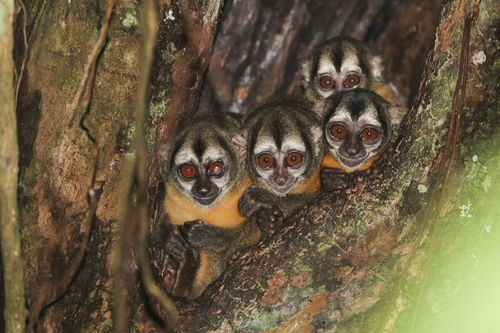
About Aotus vociferans (Spix, 1823)
Common and Scientific Names
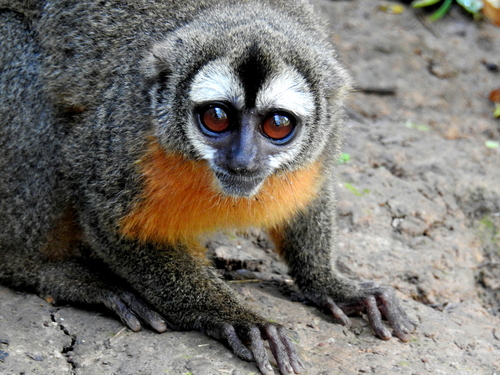
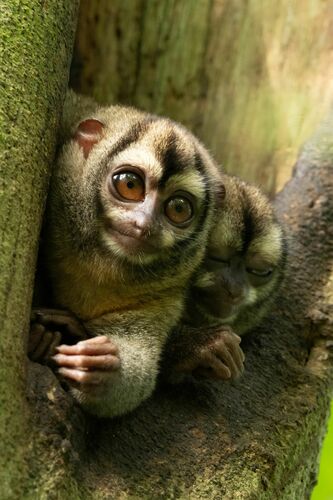
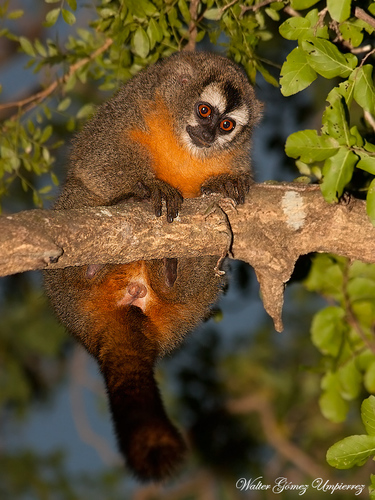
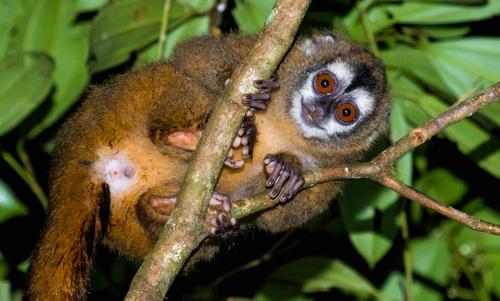
Spix's night monkey, with the scientific name Aotus vociferans (Spix, 1823), is also commonly called the Colombian gray night monkey, noisy night monkey, and Spix's owl monkey.
Geographic Distribution
It is a species of night monkey native to South America, where it is found in Brazil, Colombia, Ecuador, and Peru.
Size and Physical Measurements
This is a small-bodied monkey species with an average body mass around one kilogram and an average height of 0.5 meters.
Taxonomic Classification
It belongs to Aotus, the only nocturnal genus of New World primates, and is classified as a New World monkey.
Locomotor Adaptation
Because its arms are longer than its legs, this monkey can leap farther than most other monkeys.
Social Group Structure
The social behavior of Aotus vociferans centers on living in structured groups, which usually consist of a breeding pair and their offspring.
Mating System
This species has a monogamous mating system.
Parental Care Roles
After offspring are born, the father acts as the main caregiver, only giving the offspring to the mother to suckle.
Offspring Dispersal Age
Offspring typically remain in their birth group until they reach two and a half to three and a half years of age.
Exception to Dispersal Age
An exception occurs if the breeding male is no longer present, most often due to death; in this case, offspring may leave their birth group between twelve weeks old and the normal departure age.
Social Grooming Behavior
Social grooming is uncommon in this species.
Litter Size
Aotus vociferans usually gives birth to a single offspring at a time, though twin births can occur, similar to humans.
Female Reproductive Interval
Females have an interbirth interval of around one year between births.
Mating and Birthing Season
Both mating and birthing take place between November and January.
Copulation Duration
Copulation attempts in this species tend to be short and quick.
Copulation Initiation
The process begins when the male and female approach one another, and the male performs a social sniff.
Female Response to Initial Sniff
The female may or may not reciprocate the initial sniff.
Copulation Mechanics
Sexual intercourse usually involves just three to four male thrusts, with the male ejaculating on the final thrust.
Arboreal Locomotion Methods
This species moves through the forest by swinging between horizontal branches, using all four limbs to grip branches.
It may also leap from tree to tree.
Communication Modalities
It communicates through four modalities: voice, sight, smell, and touch.
Vocal Communication Overview
Vocally, it produces different sounds for different situations.
Predator Startle Vocalization
To startle potential predators, this night monkey will "scream", emitting a high-pitched shriek.
Olfactory Mating Assessment
The monkeys use social sniffing to assess potential breeding partners.
Scent Marking for Sexual Signaling
They also urinate on their hands and rub the urine on different surfaces to signal sexual attraction.
Male Aggressive Display
When acting aggressively, males usually arch their backs with all of their limbs straightened.
Predator Deterrence Behavior
When a predator is present, the night monkey will sway from side to side to attempt to deter the predator.
Tactile Rejection Communication
A rejection bite is used as tactile communication: between mother and offspring after suckling, or when the offspring is around one week old and contact is not welcome; between father and offspring when the offspring reaches around 8 weeks old and contact is not welcome.