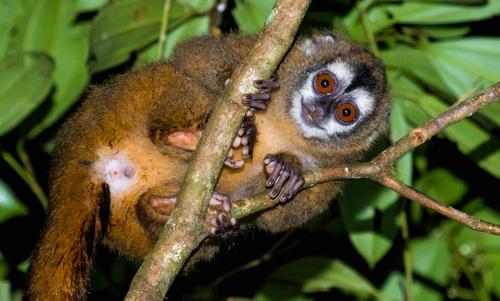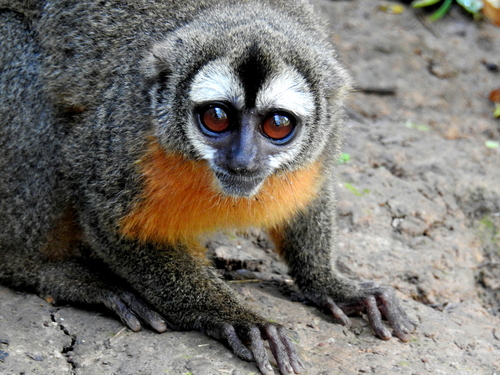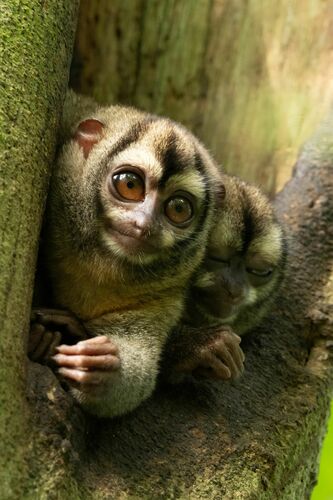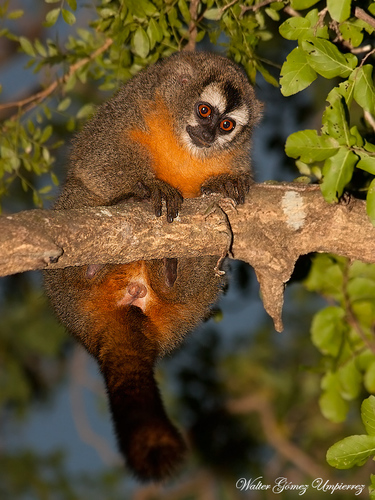
About Aotus azarae (Humboldt, 1812)
Physical characteristics
Size Measurement Data Limitations
Because of a lack of available data, body size and weight measurements for Azara's night monkey (Aotus azarae) have been estimated from only a small number of wild samples.
Length and Dimorphism
Average head and body length is 341 mm (13.4 in) for females, and 346 mm (13.6 in) for males. There is very little sexual dimorphism in this species.
Subspecies Weight Data
Average weights by sex and subspecies are: 1,254 g (2.765 lb) for male A. a. azarae, 1,246 g (2.747 lb) for female A. a. azarae, 1,180 g (2.60 lb) for male A. a. boliviensis, and 1,230 g (2.71 lb) for female A. a. boliviensis.
Reproduction and Lifespan
The gestation period of Azara's night monkey is approximately 133 days. The overall lifespan of this species is unknown, but captive individuals of the genus Aotus are thought to live up to 20 years.
Habitat and distribution
Geographic Range
Azara's night monkey is distributed across northern Argentina, Bolivia, central Brazil, Paraguay, and far southeastern Peru. Its range covers the southern Amazon, and extends into more open habitats such as the Gran Chaco.
A. a. azarae Habitat
The subspecies Aotus a. azarae inhabits gallery forest and semi-deciduous forest.
A. a. infulatus Habitat
The subspecies A. a. infulatus inhabits humid lowland forest, gallery forest, and a variety of other forest types. A. a. infulatus has been recorded at elevations up to 1,250 m (4,100 ft) in the Andean foothills.
Behavior and ecology
Social Structure
Azara's night monkey is a monogamous, pair-living species. Males stay with the family group to help raise offspring and provide food.
Offspring Dispersal
Offspring remain with their family group until they are two to three years old, then disperse to start their own families.
Diet
Azara's night monkey is primarily a frugivore, but it also consumes leaves, flowers, and insects.
Activity Patterns
Most populations are nocturnal or cathemeral, an activity pattern that greatly reduces competition with diurnal animals. This species lives entirely in trees, becomes more active during brighter moon phases, and typically sticks to well-established travel paths.
Gran Chaco Population Uniqueness
Uniquely among night monkeys, Azara's night monkey populations from the Gran Chaco are active both day and night.
Group Sleeping Behavior
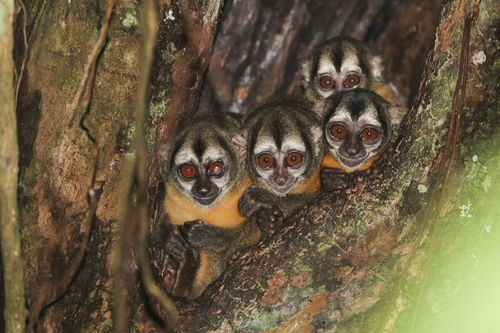
Azara's night monkey sleeps in tree groups of 2 to 5 individuals, with an average group size of around 3 monkeys: an adult breeding pair and their offspring.
Locomotion
It moves through the forest both by leaping between trees and quadrupedal movement.