About Anthurium andraeanum Linden ex André
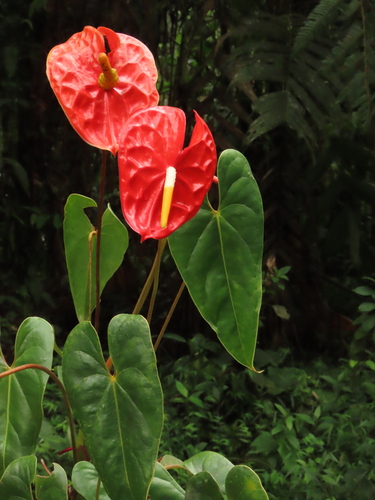
Anthurium andraeanum Linden ex André is a monocotyledonous perennial plant that prefers warm, shady, humid climates like tropical rainforests. As an ornamental species, its most distinctive features are its brightly colored spathe leaf and the protruding inflorescence called the spadix. It is a short, erect plant with entire, heart-shaped (cardioid) leaves that are generally reflexed, with a cordate base and an acuminate or cuspid apex. Leaves are held by a cylindrical petiole 30 to 40 cm long. The spathe is cartilage-waxy, brightly colored in shades of red or pink, and measures 8 to 15 cm long, not including the spadix. The spadix is 7 to 9 cm long, candle-holder shaped, white or yellow, erect, and bears many small hermaphroditic flowers. Each flower has a perianth with four segments and stamens with a compressed mesh. This species flowers year-round, and produces fleshy berry fruits. It is native to Ecuador and southwestern Colombia, and has become naturalized in other regions across the world, including the Caribbean and Réunion. It is widely cultivated as an ornamental plant in the form of many hybrids and horticultural varieties, and is commonly used to make bouquets. The entire plant is toxic. It contains saponins and fine needle-shaped calcium oxalate crystals, which can penetrate mucous membranes and cause painful irritation. It is toxic to all mammals: a fragment chewed in the mouth can cause severe irritation of the mouth and throat. Skin contact in humans causes erythema and blisters; if ingested, it causes salivation, difficulty swallowing, and vomiting.