About Anthracoceros albirostris (Shaw, 1808)
Taxonomy
The scientific name of the oriental pied hornbill is Anthracoceros albirostris (Shaw, 1808).
Size Measurements
This species is a medium-sized frugivore, with a head-to-tail length of 55–60 cm (22–24 in) and a wingspan of 23–36 cm (9.1–14.2 in). Bill length averages 19 cm (7.5 in) for males and 16 cm (6.3 in) for females. Individuals weigh between 600 and 1,050 g (21 and 37 oz), with an average weight of 900 g (32 oz) for males and 875 g (30.9 oz) for females.
Plumage Features
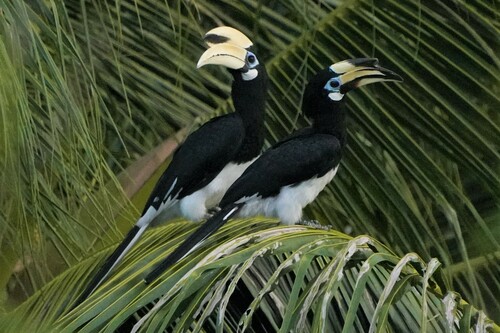
The plumage of the head, neck, back, wings, and upper breast is black with a faint green sheen. The tail is black, with white tips on all feathers except the central rectrices. The plumage of the lower breast, lower abdomen, thighs, and under-wing, plus all wing tips except the three basal secondaries and two outer primaries, is white.
Bare Skin Traits
The circumorbital skin around the eyes and throat skin is also white, and a blue tinge can sometimes be seen on the throats of adult individuals.
Casque Characteristics
The casques of mature oriental pied hornbills are laterally flattened cylinders, which may form a protruding horn.
Sexual Dimorphism
Males and females have similar overall coloration, but can be distinguished by other traits. Males are larger in body size, have a yellow bill with a black base, and bright red eyes. Females are slightly smaller in body size, have a yellow bill and casque with a partly black, brown-patched mandible, and grayish-brown eyes.
Juvenile Traits
Juvenile oriental pied hornbills resemble adults, but have an undeveloped casque, a smaller bill, and their black plumage lacks the green gloss present on adult plumage.
Vocalizations
The calls of the oriental pied hornbill have been described as crow-like sounds, braying sounds, or harsh crackles and screeches.
Distribution Range
The oriental pied hornbill has the largest distribution of any species in its genus, occurring in the Indian subcontinent and across Southeast Asia. Its range includes eastern and northern India, Nepal, Bangladesh, Bhutan, Tibet, Myanmar, Thailand, Laos, Cambodia, Vietnam, Peninsular Malaysia, Singapore, Indonesia, Brunei, and the Sunda shelf islands.
Habitat Types
Its natural habitat is subtropical or tropical moist lowland forests; it also occurs in dry and semi-evergreen forests, dry and moist deciduous forests, subtropical broadleaf forests, secondary forests, plantations, and woodlands.
Breeding Season
Hornbills as a group are generally monogamous, and breed between January and June. Oriental pied hornbills typically begin breeding in February, which aligns with the start of the rainy season (depending on geographic location) and the peak abundance of fruit.
Nest Site Selection
Oriental pied hornbills are secondary cavity nesters, meaning they typically do not dig out their own nesting sites, instead using cavities created by other birds or broken branches. Because they depend on pre-existing cavities, selection of a suitable nest site has a major impact on breeding success.
Nest Sealing Process
After a female selects a nest and enters the cavity, she seals it closed with a mixture of saliva, mud, fruit, droppings, and tree bark, leaving only a small opening through which food can be passed into the nest.
Nesting Provisioning
The male forages to feed the female and chicks, and the female feeds the nestlings. Chicks stay inside the nest with the female for several months until they are ready to fledge.
Nest Reuse
Oriental pied hornbills have been observed returning to their previous nest for later breeding seasons.