About Anolis carolinensis Voigt, 1832
Species Introduction
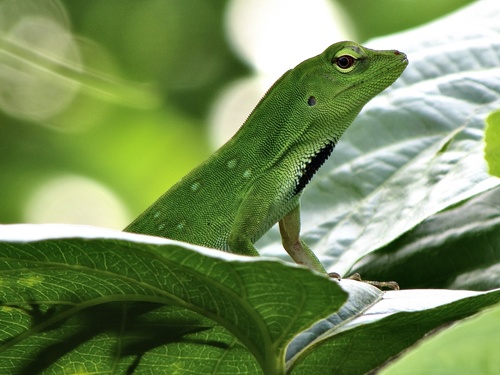
Anolis carolinensis Voigt, 1832 (the green anole) is a small to medium-sized lizard with a slender body.
Sexual Size Dimorphism
This species displays sexual dimorphism: males are 15% larger than females, with adult males typically measuring 12.5–20.3 cm (4.9–8.0 in) in total length, 60-70% of which is the tail. Adult males have a maximum snout to vent length (SVL, or body length) of 7.5 cm (3.0 in) and weigh 3–7 g (0.11–0.25 oz).
Head Structure
The head is long and pointed, with ridges between the eyes and nostrils, and smaller ridges on the top of the head.
Locomotion Adaptations
Toes have adhesive pads to aid climbing, and jumping is this species' primary form of locomotion.
Male Morphs
Within a population, adult males can be grouped into two distinct morphs: heavyweight and lightweight.
Dewlap Sexual Dimorphism
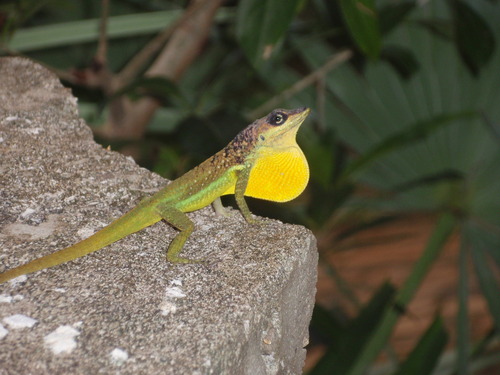
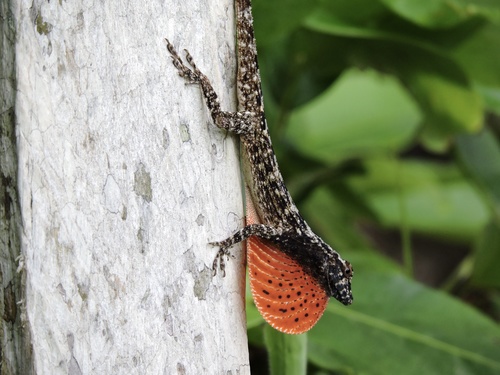
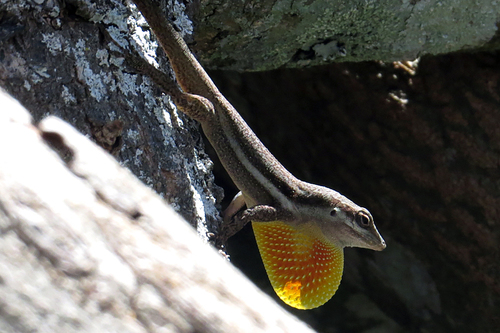
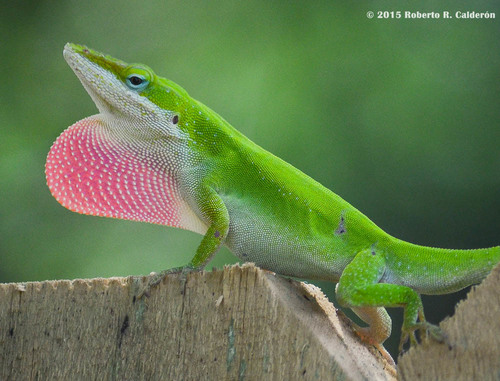
The male dewlap (throat fan) is three times the size of the female's dewlap and ranges from bright orange to red; female dewlaps are lighter in color, usually pink, and are very rarely present.
Dewlap Visual Properties
Dewlap color appears different to the lizard's eye than to the human eye. Green anoles are thought to be able to see a wider range of the UV spectrum than humans, and the dewlap reflects ultraviolet light to attract mates.
Dewlap Function
Extending the dewlap from the throat is used for communication.
Male Display Features
Males can develop a distinct dorsal ridge behind the head when displaying or under stress.
Female and Juvenile Markings
Females and juveniles usually have a prominent white stripe running along their spine, a feature that most males lack.
Native Range Overview
This species is native to North America, where it occurs mainly in the subtropical southeastern portion of the continent.
US Native Distribution
It is most abundant on the Atlantic Coastal Plain of North Carolina, South Carolina, Georgia, and Florida, and along the Gulf Coast of Alabama, Mississippi, Louisiana, and Texas, where it extends inland as far as the Texas Hill Country and the DFW Metroplex.
Mexico Range Status
It has also been recorded in Tamaulipas, Mexico, but this is most likely an introduced population.
Carolinas and Georgia Distribution
In the Carolinas, it occurs on coastal plains as far north as False Cape, Virginia, and in the southern piedmont of North Carolina; it is found throughout South Carolina, and widespread across Georgia except for the Blue Ridge region.
Introduced Pacific and Caribbean Range
The species has been introduced to multiple areas in the Pacific and Caribbean: Hawaii, the Ogasawara Islands, the Northern Mariana Islands, the Bahamas, Anguilla, Palau, and Saint Vincent and the Grenadines, as well as the Canary Islands.
Japan Invasive Status
In 2005, it was listed as an invasive alien species in Japan's Ogasawara Islands for causing the collapse of local insect populations.
European Invasion Status
Green anoles have also successfully invaded parts of Europe.
California Introduced Range
They have been sighted in Orange County and San Diego County, southern California, with San Diego sightings dating back to at least 1993.
General Habitat Use
Green anoles are arboreal by nature, but may also be found on the ground.
Human-Altered Habitat Adaptation
They are frequently seen on shrubs in the low country of the Carolinas, and can survive easily in cities such as Atlanta as long as there is plenty of vegetation and insect prey. Compared to other lizard species, green anoles are the most adapted to human encroachment.
Urban Perching and Thermoregulation
They can be seen on steps, trellises, and railings near foliage; on especially hot summer days, they may move to indoor walls or wrap-around porches of older buildings to cool off, and can easily be captured in a shoebox and gently released outdoors.
Edge and Disturbed Habitat Use
They are common along roadsides, at forest edges with shrubs and vines, and at construction sites with abundant foliage and sunlight.
Preferred Habitat
Their preferred habitat is open pine communities with higher shrub density, which supports larger anole populations by providing space to watch for prey and intruders entering their territory.
Breeding Season Timing
The typical breeding season for Carolina anoles starts as early as April and ends in late September.
Reproductive Cycle Regulation
Gonadal activity is primarily regulated by photoperiod: gonads enlarge in spring as the weather warms and days lengthen, and regress in late summer, with the highest reproductive activity occurring in mid-summer when intense heat maximizes gonadal activity.
Non-Breeding Season
From late fall until late winter or early spring, during the start of the non-breeding season, green anoles enter a refractory season.
Male Breeding Displays
During the breeding season, males patrol their territory, and this is when their most striking displays can be seen.
Male Territoriality
Males are highly territorial and can inflict serious bite wounds on other males. They defend their territory and access to females from rivals, and court females with elaborate displays: they extend their brightly colored dewlaps while bobbing up and down in a dance-like movement. The dewlap is also used to deter other males.
Mating Behavior
The male courts and pursues a female until mating is successful. Usually, when a female is ready to mate, she allows the male to catch her, and he grasps her by biting a fold of skin behind her neck. The male then positions his tail underneath the female's tail near her vent.
Male Reproductive Anatomy
Males have two sex organs called hemipenes, which are normally held inside the body but everted from the vent for mating. On successive matings, males alternate between the left and right hemipenis.
Female Reproductive Cycle
Females mature one ovarian follicle at a time, with ovaries alternating in production. The sight of a courting male triggers ovarian development, sexual receptiveness, and then ovulation.
Egg Laying
Around two to four weeks after mating, the female lays her first clutch of eggs, which usually contains one or two eggs. She can produce an egg every two weeks during the breeding season, until she has produced around 10 eggs total. She is able to store sperm for up to eight months after mating.
Egg Deposition Sites
She buries the soft-shelled eggs in a shallow depression in soft soil, leaf litter, compost, rotting wood, or even a hole in a nearby tree.
Egg Size
Eggs average 12.5 mm (0.49 in) by 9.3 mm (0.37 in) in size.
Incubation Conditions
The eggs are left to incubate using heat from the sun; successful incubation takes 30–45 days (five to seven weeks), and hatching occurs from late May to early October. The required incubation temperature is 80 to 85 °F (27 to 29 °C).
Hatchling Size
Upon hatching, hatchlings are 52–67 mm (2.0–2.6 in) in length.
Hatchling Survival
Hatchlings must fend for themselves, as they receive no parental care. They must be wary of local adult anoles, larger reptiles, and mammals that may prey on them.
Juvenile Morphology
Younger anoles differ from adults in having less obvious head ridges, a wider head, and a shorter tail.
Maturation Time
They reach maturity in about eight months.