About Anolis allisoni Barbour, 1928
Species Comparison
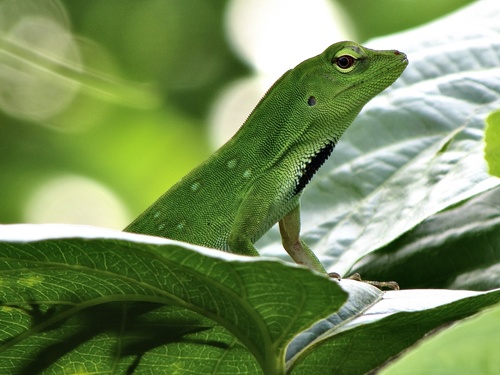
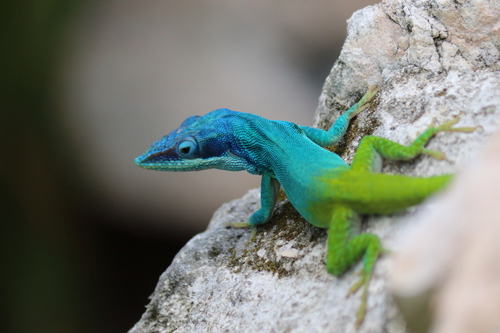
Allison's anole (Anolis allisoni Barbour, 1928) is superficially similar in color and morphology to the more well-known American green anole.
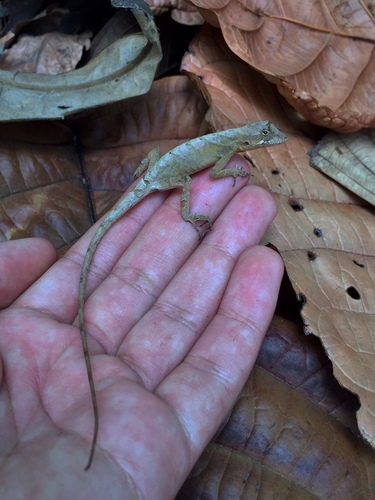
Females are overall green with paler underparts, just like the green anole.
Male Coloration
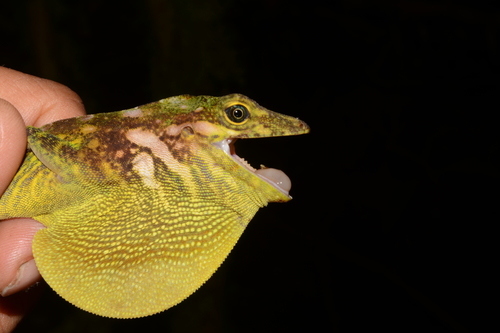
Males have a reddish-pink dewlap, and typically have bright blue heads, forelegs, and the frontal half of the body; for males from Honduras, only parts of the head are blue, with the rest of the body green.
The throat of all individuals is usually white.
Color Change Ability
Both sexes can rapidly change their color to brown.
Size
Females reach roughly 7.5 cm (3 in) in snout-vent length, while males reach about 10 cm (4 in).
It is one of the larger species in the carolinensis species group.
Ecomorph Classification
Allison's anole is classified as a typical trunk-crown anole.
Head and Crest Morphology
Like other anoles in the carolinensis group, it has a large, conspicuously triangular head, and mature males have a prominent nuchal crest.
Toepad Structure
This lizard has large subdigital toepads, which help it climb and cling to vertical surfaces.
Native Range Origin
Anolis allisoni is thought to have originated on Cuba, but has since spread to Honduras and Half Moon Caye.
Population Differentiation
This migration is believed to have occurred long ago, as the different populations across these three locations show enough phenotypic and genetic differentiation that they are being considered for subspecies status.
Extralimital Records
Only a few specimens have been recorded from the Mexican island of Banco Chinchorro.
Introduced Florida Population
The species has also been documented in several neighborhoods in southern Florida, where it survives and apparently breeds in both small parks and residential areas.
This Florida population is likely of Cuban origin, and was introduced when eggs were accidentally carried to the region with plants.
Canopy Habitat Use
As a trunk-crown anole, A. allisoni is most commonly found in the canopy and on the upper trunk of tall trees.
Vertical Height Range
It is typically found no more than 1.5 m (4.9 ft) off the ground.
Toepad Adaptation
Compared to most other anoles, it has evolved large subdigital toepads, an adaptation that helps it cling to vertical surfaces such as tree trunks.
Palm Habitat Preference
This lizard is most frequently seen on coconut palm trees.
Historical Half Moon Caye Habitat
Before coconuts were introduced to Half Moon Caye, the lizard likely filled a similar niche in the crowns of thatch palms (Thrinax radiata, also called salt water palmetto), which were completely removed from the island in 1982.
Half Moon Caye Conservation Proposal
It has been proposed that this native palm be reintroduced to the island to provide habitat for the lizards, especially since the island's coconut palm population has been gradually declining.
Urban Habitat Use
In more urban areas, this lizard is commonly found on walls and other man-made structures.
Cuban Population Status
It is a common species across Cuba, where its global population is largest.
Florida Population Trend
As of 2021, the introduced population in Florida remains restricted to a small number of neighborhoods, but their numbers are likely increasing.
Human Interaction
Many residents have already noticed the lizards, which have no fear of humans, regularly climb on building walls, and nest in residential yards.