About Anodorhynchus leari Bonaparte, 1856
Scientific Classification and Size
Lear's macaw, scientifically named Anodorhynchus leari Bonaparte, 1856, measures 70–75 cm (27+1⁄2–29+1⁄2 in) in length and weighs approximately 950 g (2 lb 2 oz).
Plumage Coloration
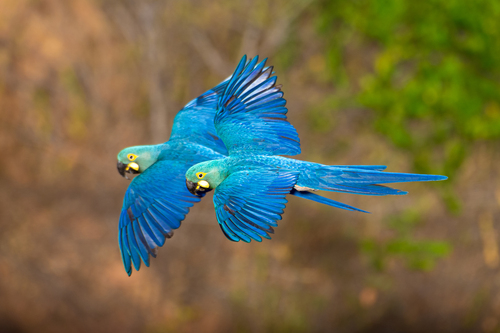
Its body, tail, and wings are dark metallic blue with a faint, often barely visible, green tinge, and its head is a slightly paler blue shade.
Soft Part Morphology
It has a patch of pale-yellow skin next to the base of its beak, orange-yellow eye rings, a large blackish beak, and dark grey feet.
Similar Species Comparison
Lear's macaw resembles two related species: the larger hyacinth macaw and the slightly smaller glaucous macaw. Hyacinth macaws can be told apart by their darker plumage, absence of a greenish tinge, and differently shaped yellow skin patch at the base of the bill, while glaucous macaws are paler overall and have a more greyish head.
Early Species Documentation
For 150 years after this species was first described, it was only known from sporadic specimens appearing in the bird trade, and the location of its wild population remained unknown.
Wild Population Discovery
A wild population was finally discovered in 1978 by ornithologist Helmut Sick in Bahia, in the interior of northeast Brazil. Before this discovery, birds of this species were thought to be simply a variant form of the closely related hyacinth macaw.
Roosting Habitat
Lear's macaw roosts on sandstone cliffs formed by streams cutting through rock outcrops.
Known Roosting Colonies
Before 1995, it was only known from two colonies at Toca Velha and Serra Branca, located south of the Raso da Catarina plateau in northeast Bahia. In 1995, a roosting site holding 22 birds was found 200 km (120 mi) west of these colonies at Sento Sé/Campo Formoso.
Foraging Range
From their roosting sites, the macaws range across the surrounding region, covering the municipalities of Campo Formoso, Canudos, Euclides da Cunha, Jeremoabo, Monte Santo, Novo Triunfo, Paulo Afonso, Santa Brígida, and Sento Sé.
Primary Food Source
They get most of their food from stands of licury palm.
Licury Palm Habitat Loss
Historians believe this palm habitat once extended across 250,000 km2 (97,000 sq mi) of Brazil, but it has been greatly reduced by land clearance for agriculture. Cattle grazing within remaining palm stands also damages and kills young palm seedlings, making it hard for new mature palms to grow; surveys of these stands found very few young licury palms growing.
Palm Habitat Restoration
In the early 2000s, tens of thousands of licury palms were propagated from existing stock and planted in fenced protected areas to address this loss.
Nesting Site Requirements
Lear's macaw also relies on existing natural cavities in sandstone cliffs to build its nests.
Nesting Limitation and Conservation Recommendation
The limited number of these natural cavities may eventually restrict the species' population growth, so one group of conservationists has recommended that additional nesting cavities be excavated artificially.