About Anhinga melanogaster Pennant, 1769
Species Identification
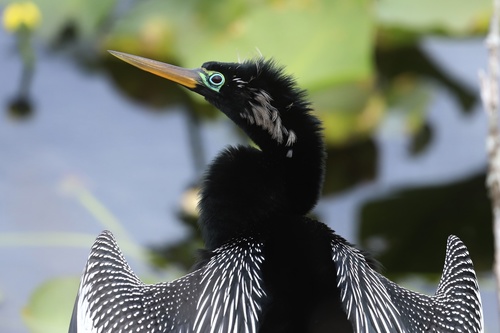
This species is the Oriental darter, a cormorant-like bird with a very long neck, similar to all other anhingas.
Neck Vertebrae Structure
Like other darter species, its neck structure has strongly developed muscles around a kink at the 8th and 9th vertebrae. This adaptation lets the neck flex and dart forward rapidly and forcefully to stab fish underwater.
Mandible Serrations
The edges of the mandible tip commissures have tiny inward-pointing serrations that hold impaled fish.
Upper Body Plumage
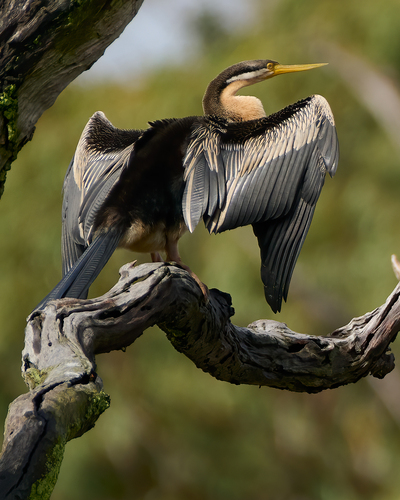
Adult Oriental darters have black plumage on their upper body, with silvery streaks running along the shaft of the wing coverts and tertials.
Crown and Neck Coloration
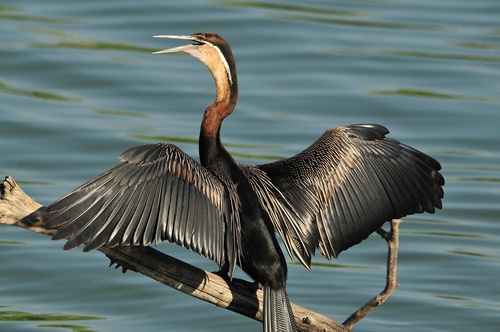
The crown and neck are brown, shading to black toward the back of the neck. Underparts are blackish brown.
Facial and Neck Stripes
A pale stripe above the eye and throat, plus another stripe running along the sides of the neck, creates a striped appearance.
Iris Coloration
The iris is white, surrounded by a yellow ring that is brighter yellow in breeding birds.
Bill Coloration
The tip of the upper mandible is dark, while its base is pale brown, and the lower mandible is yellowish.
Leg and Foot Coloration
For immature and non-breeding birds, the legs and foot webbing are yellow. Breeding birds have darker grey tarsi and toes, with yellow webbing.
Male Plumage Traits
The sexes are not easily distinguished, but males usually have black speckles that coalesce on the white throat.
Female Plumage Traits
Adult females have a shorter bill, and the black on the base of the neck and chest is separated from the hind neck by a wide buff band that ends at the shoulder.
Immature Plumage Traits
This same pattern appears in immature birds, which have a lighter neck and lack long pointed scapulars.
Flight Silhouette
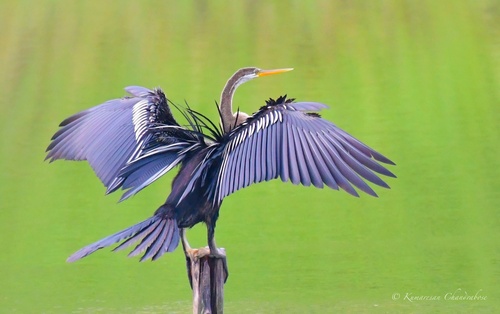
In flight, the species is distinctive for its long slender neck, wide wings, and wedge-shaped tail.
Young Bird Plumage
Young birds have a pale brown neck, a whitish underside, and lack the white streak along the side of the neck.
Feather Texture
The inner secondaries, also called tertials, and central tail feathers have a wavy or corrugated appearance.
Tail Structure
The tail is long, made of twelve stiff feathers that are dragged along the ground when the bird walks or hops on land.
Habitat
The Oriental darter occurs mainly in freshwater lakes and streams.
Foraging Submersion Behavior
They most often forage alone, with their entire body submerged. They swim slowly forward using their webbed feet, while moving their head and neck jerkily above the water.
Feeding Process
They dart their neck to impale fish, then bring the fish out of water, toss it into the air, and swallow it head first.
Wing Drying Behavior
They may sometimes be found alongside cormorants, which share the habit of spreading their wings to dry while perched on a waterside rock or tree.
Flight Behavior
They sometimes soar on thermals during the warm part of the day, and alternate flapping and gliding during normal flight.
Nesting Location
They nest in mixed-species heronries, building a stick platform nest on a nest tree that is usually surrounded by water. Multiple pairs may nest close to one another.
Nest Construction
Before placing the sticks that form the nest platform, the birds flatten the chosen branch. They defend nest sites from other birds with posturing and neck thrusts.
Breeding Season Timing
The breeding season runs from June to August, the rainy season, in northern India; from April to May in southwestern India; and falls in winter, during the northeast monsoon, in southeastern India.
Clutch Characteristics
A typical clutch holds three to six spindle-shaped bluish-green eggs with a white chalky covering that becomes soiled over time.
Incubation Behavior
Both parents incubate the eggs, starting incubation after the first egg is laid. This leads to asynchronous hatching of the young.
Chick Down Development
Newly hatched chicks are naked, with only a small amount of down on the head. As they grow, they become fully covered in white down.
Chick Feeding Behavior
Chicks feed by thrusting their heads down the throat of their parent.
Post-Breeding Moult
After the breeding season, adults undergo a synchronous moult of their flight feathers, which leaves them unable to fly for a short period. When disturbed from their perches during this moult, they dive into the water below and escape by swimming underwater.
Chick Escape Behavior
Chicks at the nest use the same escape behaviour.
Vocalizations
They are very silent except when at the nest, where they produce grunts, croaks, and a repeated disyllabic chigi-chigi-chigi call. Chicks are noisy when begging for food.
Roosting Behavior
Adults roost communally in trees close to or over water.
Predation Threats
Chicks, especially those more than half grown, are sometimes preyed on by raptors such as Pallas's fish eagle (Haliaetus leucoryphus).
Historical Human Use for Decoration
The long scapular feathers of the Oriental darter were once popular for decorating hats.
Parasite Records
Several species of parasites have been recorded from adult birds, including the trematode Schwartzitrema anhingi, as well as Petasiger nicolli, Mesorchis pendulus, and Echinorhynchotaenia tritesticulata, a cestode in the family Dilepididae.
Use in Cormorant Fishing
In parts of northeastern India, tribals have used or still use darters to catch fish from streams. A ring is tied around the bird's neck to prevent it from swallowing caught prey, a practice matching the cormorant fishing used in parts of Southeast Asia.