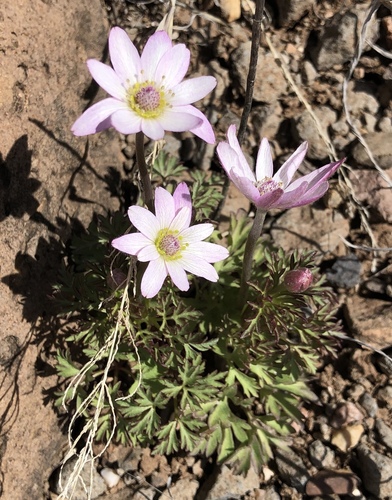
About Anemone tuberosa Rydb.
Anemone tuberosa, commonly known as desert anemone or tuber anemone, is a herbaceous flowering plant species in the buttercup family, Ranunculaceae. Individuals grow 10 to 30 cm tall, occasionally reaching up to 40 cm (16 inches), growing from a woody-textured tuber that resembles a caudex in shape. Each plant produces 1 to 3 basal leaves, which are 1 to 2 times ternate. These few basal leaves have long petioles, are deeply divided into 3 parts, and their leaflets lack stems, or rarely have a small stalk. Flowering occurs from early to late spring. Each flower is made up of 8 to 10 sepals, which are typically white or pink, and measure 10 to 14 mm (0.39 to 0.55 inches) long. Each plant produces one peduncle that holds either a single solitary flower, or a cyme with 2 to 5 flowers. Fruits form in fusiform-shaped heads, borne on pedicels 7 to 20 cm (2.8 to 7.9 inches) long. The fruits are achenes, which measure 2.5 to 3.5 mm (0.098 to 0.138 inches) long and 2 to 2.5 mm (0.079 to 0.098 inches) wide. They have a rounded outline and a flattened shape, are densely woolly, not winged, and bear straight 1.5 mm (0.059 inch) long beaks. Anemone tuberosa is native to southern, central, and western North America. It occurs most commonly in Nevada, New Mexico, and northern Mexico, but ranges as far west as California and as far east as Texas. This spring-flowering species grows on rocky slopes and along stream banks. Anemone tuberosa is part of a species complex that contains 6 to 9 species native to the southwestern and central United States, extending south to South America. Most species in this complex produce tubers, or caudex-like tubers.