About Anemone nemorosa L.
Scientific Name and Growth Habit
Anemonoides nemorosa (syn. Anemone nemorosa L.) is a rhizomatous herbaceous perennial plant that grows less than 30 centimetres (12 inches) tall.
Leaf Structure
Its compound basal leaves are palmate or ternate, meaning they are divided into three lobes.
Rhizome and Dormancy
The plant grows from underground root-like stems called rhizomes, and dies back to the ground by mid-summer, going dormant in summer.
Blooming Period
It begins blooming in spring, from March to May in the British Isles, shortly after new foliage emerges from the ground.
Flower Arrangement and Bracts
The flowers are solitary, held above the foliage on short stems, with a whorl of three palmate or palmately-lobed leaf-like bracts positioned under the flower.
Flower Size and Reproductive Parts
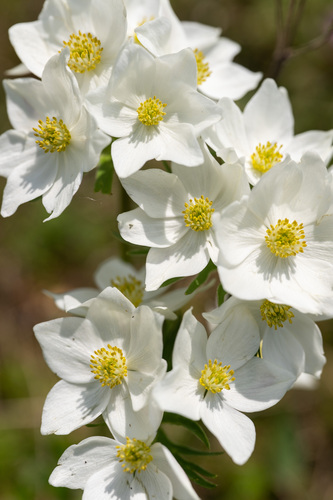
The flowers are 2 centimetres (0.8 inches) in diameter, with six or seven (and rarely eight to ten) petal-like tepals and many stamens.
Flower Coloration
In the wild, flowers are usually white, but may also be pinkish, lilac, or blue, and often have a darker tint on the back of the tepals.
Native Range
The native range of Anemonoides nemorosa extends across Europe into western Asia, and reaches as far south as the Caucasus Mountains in Turkey.
Introduced Range
It has been introduced into New Zealand and other areas.
North American Naturalized Populations
In North America, naturalized populations exist at well-known sites in Newfoundland, Quebec, and Massachusetts.
Habitat
This species is often found in shady woods.
Growth Rate in British Isles
It is common across the British Isles, but spreads very slowly there, growing as little as six feet per century.
Ancient Woodland Indicator
Because of this slow spread, it is often used as an indicator of ancient woodland.
Pollination
The flowers are pollinated by insects, especially hoverflies.
Seed Type
Its seeds are achenes.
Cultivar Introduction
Many cultivars have been selected for garden use.
UK Cultivar Listing
The RHS Plant Finder 2008–2009 lists 70 cultivars sold by nurseries in the United Kingdom.
Popular Cultivars
Some of the most widely available are: 'Alba Plena', with double white flowers; 'Allenii' agm, with large lavender-blue flowers, often with seven petals, named after nurseryman James Allen; 'Bowles' Purple', with purple flowers, named after plantsman and garden writer E.A. Bowles; 'Bracteata Pleniflora', with double white flowers that have green streaks and a frilly ruff of bracts; 'Robinsoniana' agm, with pale lavender-blue flowers, named after plantsman and garden writer William Robinson; 'Royal Blue', with deep blue flowers that have purple backs; 'Vestal' agm, with white anemone-centred flowers; 'Virescens' agm, with flowers mutated into small conical clusters of leaves.
Award of Garden Merit Explanation
Cultivars marked agm have received the Royal Horticultural Society's Award of Garden Merit.
Hybrid Species
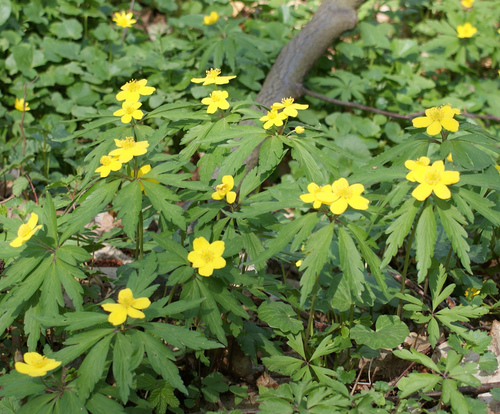
Anemonoides × lipsiensis, a hybrid between A. nemorosa and A. ranunculoides, produces pale yellow flowers.
Hybrid Cultivar
A. × lipsiensis 'Pallida' is the best-known result of this cross, and it has also been awarded the Award of Garden Merit.