About Anemone multifida Poir.
Taxonomic Identity
Anemone multifida Poir. is a variable perennial herb, with appearance differing notably across its varieties.
Growth Form
It grows from a branching caudex, reaching heights between 10 and 70 centimeters.
Leaf Pubescence
Its long-petioled leaves are covered in a layer of long silky or coarse white hairs.
Leaf Lobing
Each leaf is split into many long, pointed lobes, and these lobes are sometimes further subdivided.
Leaf Size
A single complete leaf, including its petiole, can measure 5 to 20 centimeters long.
Basal Leaf Structure
Basal leaves are divided two or three times into narrow segments.
Inflorescence Arrangement
The inflorescence bears one or more flowers.
Flower Sepals
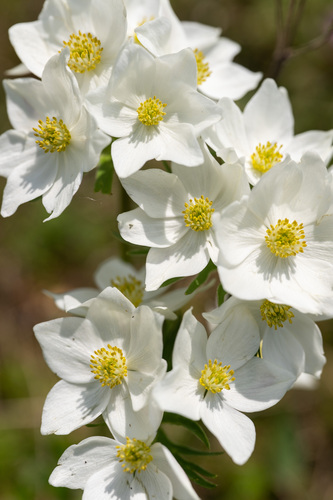
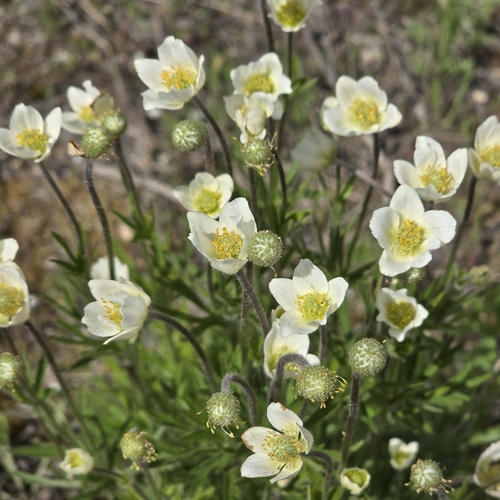
The flowers do not produce petals, and instead have four to eight, most commonly five, petal-like sepals.
Sepal Characteristics
These sepals can be almost any color, but are typically white, and are somewhat hairy, particularly on their outer surface.
Flower Stamens
The center of the flower holds up to 80 stamens.
Fruit Traits
Its fruit is a woolly achene covered in long hairs, tipped with a beak, and measures a few millimeters in length.
General Habitat
Anemone multifida grows on calcareous ledges, in areas with rocky or gravelly soils near lakes and other waterways, and on dunes.
Regional Habitat Record
It has been recorded growing in prairie habitat in Minnesota.
Primary Distribution
It most commonly occurs in subarctic and boreal regions of western and central North America, but some populations are also found in mountainous and temperate habitats in the southern portions of its North American range.
Eastern North America Distribution
It also occurs in the Great Lakes region, with rare populations documented in northeastern United States states and eastern Canada.
Toxicity and Chemistry
A. multifida is poisonous, as it contains high levels of ranunculin: approximately 8.1% by dry weight in aerial plant parts, and 4% by dry weight in the root.