About Androcalva fraseri (J.Gay) C.F.Wilkins & Whitlock
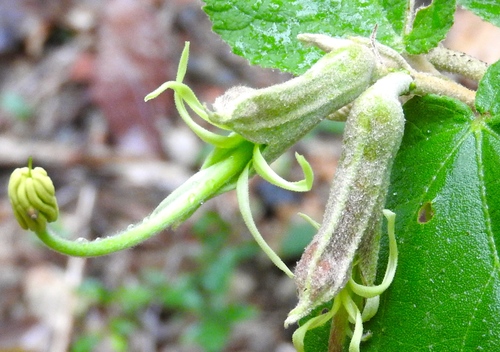
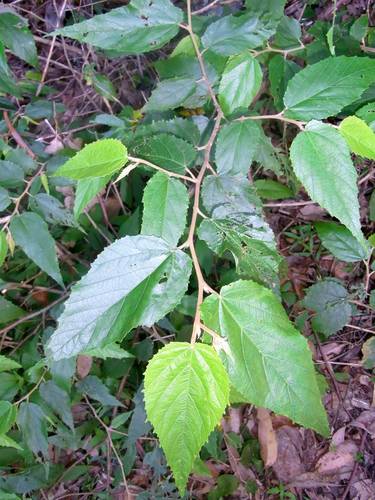
Androcalva fraseri is a small tree or shrub that typically reaches 3–9 m in height and 2–4 m in width. It forms suckers and has a trunk that can grow up to 15 cm in diameter. Its leaves are arranged alternately along stems, and can be egg-shaped to broadly triangular, or broadly lance-shaped to heart-shaped. Leaves range from 6–160 mm long and 50–80 mm wide, and grow on a petiole up to 15 mm long. 2–3 mm long stipules are present at the leaf base, but fall off as leaves mature. Leaf edges are irregularly toothed; the upper leaf surface is dull green and sparsely hairy, while the lower surface is covered in fine, silvery, star-shaped hairs. White flowers of this species grow in clusters of 13 to 21 on a 30–110 mm long peduncle. Each individual flower sits on a 3–8 mm long pedicel, with 2–12 mm long bracts at its base. Flowers are 6–10 mm wide, with 5 white petal-like sepals and 5 petals, and the ligule is slightly longer than the sepals. Between each pair of stamens are 3 staminodes: the central staminode is spatula-shaped, and the other two are linear. Flowering occurs from August to April, peaking between September and November. The fruit is a bristly capsule 15–20 mm in diameter. Androcalva fraseri grows in rainforest and wet eucalypt forest along and east of the Great Dividing Range in New South Wales and southeastern Queensland. In wet eucalypt forest habitat, it is associated with the tree species Angophora floribunda (rough-barked apple), Syncarpia glomulifera (turpentine), and Eucalyptus saligna (Sydney blue gum). This is a fast-growing plant that can colonize disturbed ground, especially in areas where vegetation has been partly cleared, such as under power lines. Ecologically, this species acts as an adult host plant for the chrysomelid beetle Podagra submetallica. In horticulture, Androcalva fraseri propagates readily from cuttings taken in winter, and grows better with additional moisture when under cultivation.