About Selenidera gouldii (Natterer, 1837)
Size
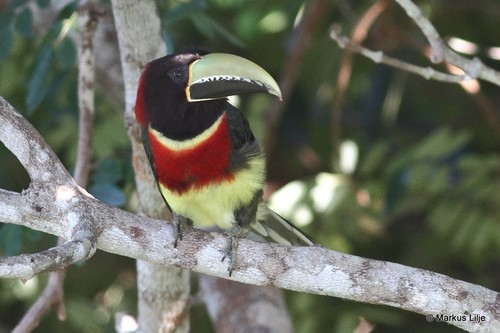
Gould's toucanet, Selenidera gouldii, reaches approximately 33 cm (13 in) in total length. Males weigh between 138 and 209 g (4.9 to 7.4 oz), while females weigh between 131 and 183 g (4.6 to 6.5 oz).
Bill Sexual Dimorphism
Males and females share the same bill color pattern, though the female's bill is shorter than the male's.
Maxilla Structure
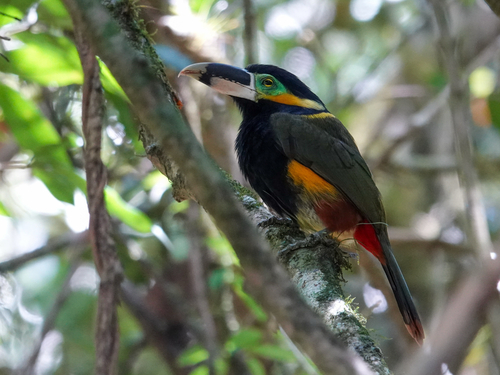
The bill's maxilla has a narrow white base, a black middle section, an orange-yellow outer third, and ivory-colored "teeth" along the cutting tomium edge.
Mandible Structure
The inner half of the mandible is ivory, with a thin black area between this inner half and the orange-yellow color of the outer end.
Periocular Features
Both sexes have bare green-yellow to blue skin surrounding the eye, plus a golden-yellow tuft of feathers behind the eye; both the bare skin and feather tuft are paler in females than in males.
Male Plumage (Head and Torso)
Adult males have black feathers on the head, nape, chin, throat, and belly. Their upperparts are green, with a yellow band on the lower neck.
Male Tail Plumage
Their tail is green, with chestnut-colored tips on the central one to three pairs of tail feathers.
Male Flank and Undertail Plumage
Males have yellow flanks and red undertail coverts.
Female Plumage
Females have chestnut-colored feathers in all areas that are black on males, plus yellower flanks and a narrower yellow band on the back.
Immature Plumage and Bill
Immature Gould's toucanets are duller in overall coloration than adults, usually lack the yellow band on the back, and do not have a sharply defined bill pattern.
Northern Distribution Range
Gould's toucanet is distributed in central and eastern Brazil, south of the Amazon River, between the Madeira River and the Atlantic Ocean in the state of Ceará.
Southern Distribution Range
Its range extends south from this area to as far as eastern Bolivia and the Brazilian state of Mato Grosso.
General Habitat Types
The species lives in a variety of tropical forest types. It is primarily found in wet lowland forest and gallery forest, but also occurs in palm forest, deciduous forest, and secondary forest.
Preferred Forest Characteristics
It favors tall forest that reaches up to 40 m (130 ft) in height, but grows on sandy soils in areas with shorter trees.
Elevational Range
In eastern Amazonia, its elevational range reaches as high as 800 m (2,600 ft).