About Andesanthus lepidotus (Humb. & Bonpl.) P.J.F.Guim. & Michelang.
Taxonomy and Growth Form
Andesanthus lepidotus (Humb. & Bonpl.) P.J.F.Guim. & Michelang. is a woody tree that most commonly grows 5 to 12 meters (16 to 39 feet) tall, and can reach up to 20 meters (66 feet) in height. It forms a vase shape with a spreading rounded crown and thick, woody branching stems.
Trunk Characteristics
Its trunk can grow up to 80 centimeters (31 inches) in diameter at the base, and has reddish, flaking bark.
Foliage Traits
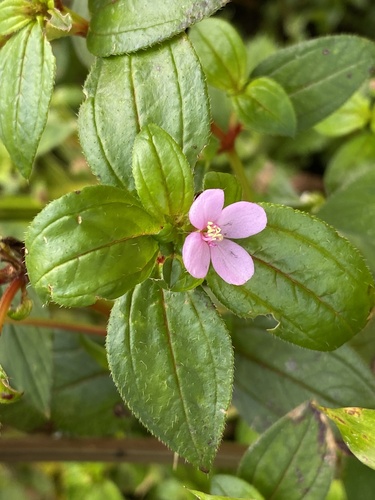
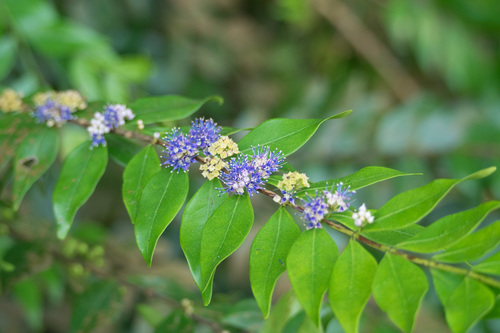
This species is evergreen, with dark green leaves that have lighter undersides and prominent longitudinal veins. The leaves are simple, opposite, coarsely hairy, and have a serrated edge, a rounded base, and a blunt tip.
Leaf Size
Mature leaves measure 8 centimeters (3.1 inches) long and 4 centimeters (1.6 inches) wide.
Leaf Aging
As leaves age, they turn crimson and become covered in small brown scales.
Native Distribution
This plant is native to the Andes Mountains, found in Venezuela’s Merida and Táchira states, 10 provinces of Ecuador, the central Peruvian regions of Amazonas, Huanuco, and San Martin, the Andean region of Colombia, and Panama.
Habitat and Elevation
It grows naturally in montane humid and cloud forests at elevations between 800 meters (2,600 feet) and 3,200 meters (10,500 feet) above sea level; in Colombia, it grows wild in temperate and cool thermal zones.
Ornamental Use
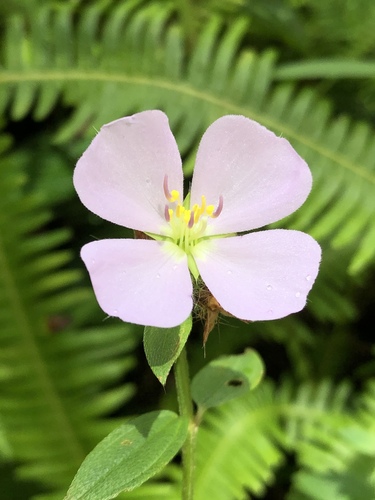
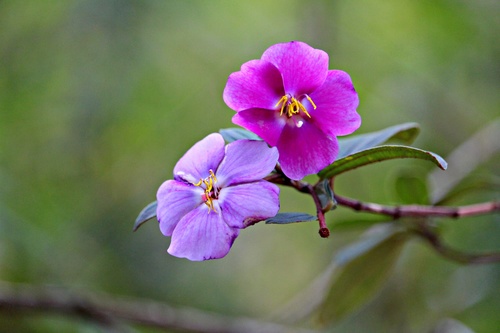
Andesanthus lepidotus is cultivated as an ornamental plant valued for its violet flowers. It grows best in full sun to partial shade, and is commonly planted in parks, public squares, and gardens.
Wood Uses
Its wood is used to make fencing posts, tool handles, and furniture, and also used as firewood.
Cultivation Requirements
Pruning after flowering encourages dense, bushy growth. The species cannot tolerate severe frost or drought, but can survive in cooler areas if given shelter, and can survive in dry conditions if watered regularly.
Propagation Method
It is propagated by seed.