About Memecylon pauciflorum Blume
Taxon Identity and Growth Form
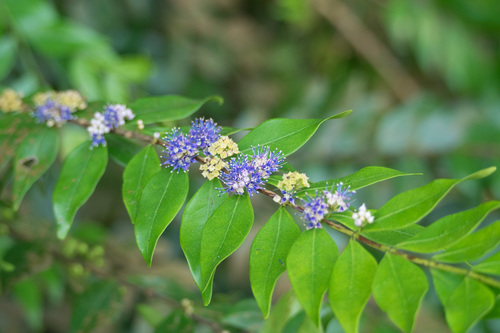
Memecylon pauciflorum Blume is a tree or shrub that grows up to 10 m (33 ft) tall, with a trunk that rarely exceeds 30 cm (12 in) in diameter.
It is many-branched, with smooth 4-sided branches.
Leaf Size and Venation
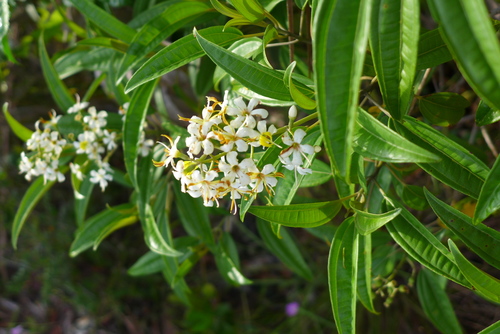
Its leaves grow up to 7 cm (2.8 in) long by 3 cm (1.2 in) wide; lateral veins are barely visible on the leaf upper surface, and form inconspicuous loops or an intramarginal vein located quite close to the leaf margin.
Small oil dots are visible on leaves under low magnification such as with a hand lens.
Stipule and Petiole Features
Stipules are absent, but scars are visible on twigs between petioles that resemble stipular scars.
The upper surface of the petiole is grooved.
Inflorescence Traits
Its inflorescences are shorter than the leaves.
Flower Characteristics
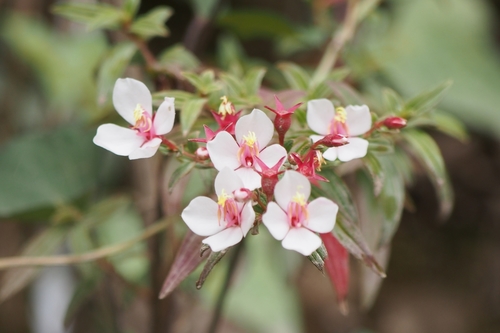
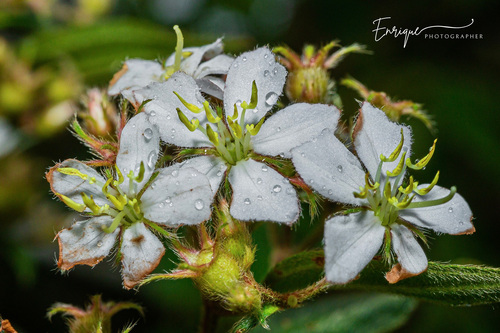
The flowers are small, pink or green, with petals about 2 mm (0.08 in) long.
There are eight stamens, and the anthers have a long spur at the base, with a raised gland on the side opposite to filament attachment.
Fruit Morphology
The fruit are globose or depressed globose, about 8 mm (0.31 in) long and 9 mm (0.35 in) in diameter, with a persistent calyx at the apex.
Seed Morphology
Seeds are globular, about 4–5 mm (0.16–0.20 in) long by 5–6 mm (0.20–0.24 in) in diameter, each weighing around 130 mg (2.0 gr).
Cotyledon and Hypocotyl Traits
The cotyledons are crumpled and folded many times, more or less semiorbicular in seedlings, shortly petiolate and around 16–20 mm (0.63–0.79 in) by 15–30 mm (0.59–1.18 in) in size.
Stipules on cotyledons are usually visible, and the hypocotyl is winged.
Tenth Leaf Stage Features
At the tenth leaf stage, the glabrous leaves are linear, ranging from narrowly elliptic to elliptic, with stipules or stipule-like structures usually visible.
Germination Period
Seed germination takes 20 to 63 days.
Flowering and Fruiting Periods
Flowering occurs in January, February or April in the Kimberley region of Western Australia, and in April and May in China, where fruiting occurs in November.
Species Distinguishing Features
This species can be distinguished from other Memecylon species native to China by these characteristics: it is a shrub or small tree less than 6m tall; leaf blades measure 3.5-8 cm by 0.6-3.5 cm; leaf blades are 1.4-3.2 times as long as they are broad, with a base that is not decurrent on the petiole; the anther has a circular concave gland connected abaxially; leaf blades are smooth and glossy on both surfaces; fruit is not ribbed; inflorescences are cymose; leaf blades are glabrous and glossy on both surfaces.
Native Distribution Range
This species is native to a range extending from northern Australia to tropical and subtropical Asia.
It grows in the following countries and regions: Australia (Queensland, Northern Territory, Western Australia); Malaysia (Peninsular Malaysia); Vietnam; China (Hainan, Guangdong); Laos; Myanmar; Bangladesh; India (Andaman Islands).
Australian Distribution Details
In Queensland, Australia, it occurs from the southeastern region through central- and north-eastern Queensland to Cape York Peninsula.
In Western Australia, it is found in the northern Kimberley.
Elevation Range
In Australia, M. pauciflorum grows at elevations from near sea level up to 400m.
Habitat in Australia
It occurs as an understory tree in monsoon forests, drier or more seasonal rainforests, open forests, littoral forests, and woodlands.
In the Kimberley, Western Australia, it grows on sandy soils in sandstone gorges.
Habitat in China
In China, it is found in forests and on mountain slopes.
Queensland Vegetation Association
A Queensland Herbarium publication on broad vegetation groups in Queensland documents multiple vegetation communities that include this species.
Rock-haunting Possum Scent Deposition
The rock-haunting possum Petropseudes dahli uses this tree as a site for scent deposition, alongside ten other tree species, rocks and termite mounds for scent-marking.
The scent is produced by caudal glands on the possums' rumps, and cloacal secretions may also be involved.
Possum Scent Characteristics
The secretion is orange-coloured, molasses-like in texture, and has a sweet, musky odour that humans can detect from up to 50m away.
Langkawi Habitat and Abundance
In the Kilim Karst Geoforest Park area of Langkawi, Malaysia, this plant grows in association with mangrove forests and is moderately abundant.
Fungal Host Associations
It is a host to the pathogenic fungi Botryosphaeria purandharensis and Mycosphaerella multiloculata, as well as the other fungi Acrocordiella occulta, Lecideopsella gelatinosa and Meliolina memecyli.
Cape York Traditional Medicine Use
In the traditional medicine of the Kuuku I’yu (Northern Kaanju) or Kaanichi Pama people, who live in the inland highlands of central Cape York Peninsula, northeast Australia, this plant is used to treat skin infections and inflammations.
Leaf Extract Bioactivity Assessment
Enzyme inhibitory activity, antiglycation activity and antioxidant activity of the species' leaf extract were assessed, and the results found these activities were not significant.
Karen Ethnomedicine Use
The Karen people of northern and western Thailand use this species in their ethnomedicine: a decoction of the leaves is drunk to treat muscle pain.