About Anarhynchus frontalis Quoy & Gaimard, 1832
Common Name and General Appearance
Anarhynchus frontalis, commonly called the wrybill, is a small, plump plover.
Size and Weight
It measures 20 to 21 cm (7.9–8.3 in) in length and weighs between 43 and 71 g (1.5–2.5 oz).
Plumage Dimorphism Overview
Its plumage shows slight sexual dimorphism.
Male Breeding Plumage
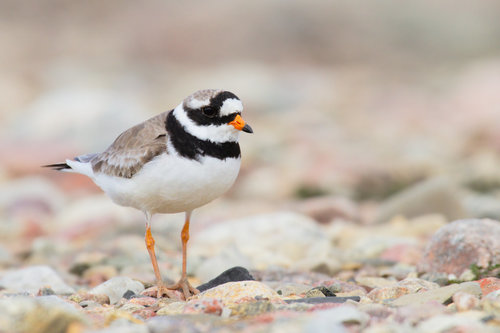
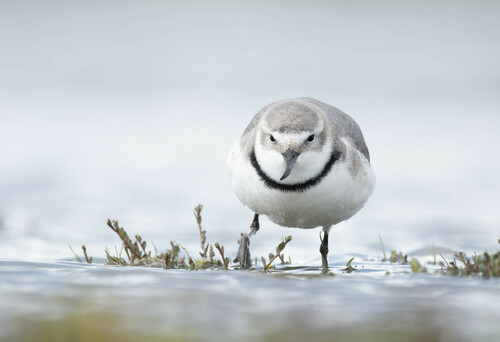
Males have a white forehead, pale grey crown, nape, back, wings and tail, and white throat, breast, belly and rump, with a thin black band across the breast.
Female Breast Band
In females, this breast band is thinner.
Non-breeding Plumage Breast Band
In non-breeding season, the band is much less distinct in both sexes.
Male Forehead Marking
Males also have a small black bar between the white forehead and grey crown, which is absent in females; like the breast band, this marking is reduced in the non-breeding season.
Distinctive Bill Morphology
The wrybill's most distinctive feature is its long black bill, which is always curved to the right.
Bill Asymmetry Uniqueness
It is the only bird species with an asymmetrically turned bill.
Egg Appearance
Wrybill eggs are very pale grey, covered in very small brown spots that blend well with surrounding shingle.
Camouflage of Adults and Chicks
In addition to the eggs being well camouflaged, adult birds and chicks are very difficult to see when standing still.
Chick Plumage
Chicks have very pale grey upper bodies with black speckles, and white lower bodies.
Vocalization Types
The wrybill's vocalizations have distinct forms: a short weet, given in flight to signal alarm; a harsher call for signaling greater alarm; a chirring sound used to challenge aggressors; and a high-pitched short peep used by fledglings and juveniles.
Endemic Range
The wrybill is endemic to New Zealand.
Breeding Habitat Preferences
It breeds on large braided rivers in Canterbury and Otago, South Island, preferring large dynamic rivers that do not become overgrown with weeds.
Main Breeding Rivers
Its main breeding rivers include the Waimakariri, Rakaia, Rangitata, Waitaki and Ashley.
Historical Range Contraction
It once occurred more commonly on smaller rivers, but has undergone a range contraction, and now only occupies around 60% of its estimated original range.
Post-breeding Migration Destinations
After breeding, from around late December to early February, the species leaves its breeding sites and migrates to shallow estuaries and sheltered coastal areas in the North Island, including the Firth of Thames, Manukau Harbour, Kaipara Harbour and Tauranga Harbour.
Moulting Period
Wrybill moulting occurs between December and May.
Moulting Process Progression
The moulting process advances quickly at the start, when the first feathers are dropped, and slows as the longer outer feathers begin to grow.
Fledgling Migration Start
Migration away from breeding grounds starts in November with the earliest fledged birds.
Adult Post-breeding Migration
Adults follow in January–February after breeding is complete, along with the remaining fledglings.
Return Migration Timing
Migration back to South Island breeding sites occurs in August.
Current Total Population
The current total population of wrybills is around 5000 individuals.