About Amphiprion perideraion Bleeker, 1855
Body Coloration
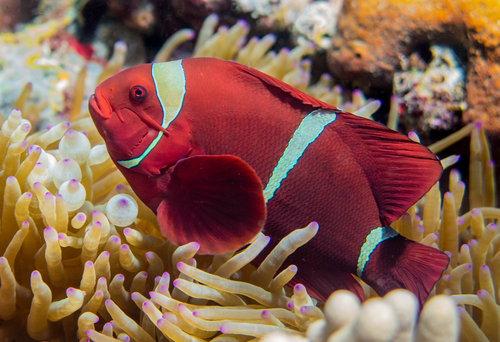
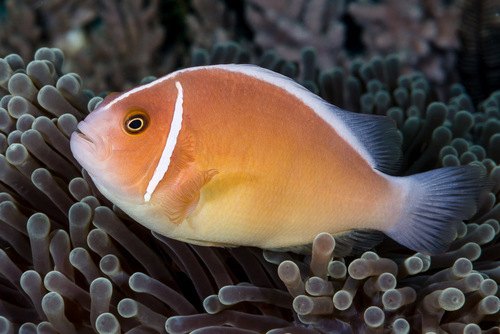
The body of Amphiprion perideraion is pink to peach in color.
Body Markings
It has a white stripe running along its dorsal ridge, a trait shared by all members of the anemonefish skunk complex, plus a vertical white head bar positioned just behind the eye.
Species Size
While the largest anemonefish species can reach 18 cm (7.1 in) in length, A. perideraion is one of the smallest species: females grow to a maximum length of 10 cm (3.9 in).
Distribution Overview
A. perideraion is distributed across the Malay Archipelago and Melanesia.
Western Pacific Range
Its range extends through the western Pacific Ocean from the Great Barrier Reef and Tonga, northward to the Ryukyu Islands of Japan.
Eastern Indian Ocean Range
In the eastern Indian Ocean, it occurs from Ningaloo Reef in Western Australia, through the Rowley Shoals, Scott and Ashmore Reefs, Cocos (Keeling) Islands and Christmas Island, to Sumatra.
Habitat Type
This species inhabits reef lagoons and outer reef slopes.
Depth Range
It was previously thought to only occur at depths of 3–20 m, but surveys conducted with autonomous underwater vehicles on mesophotic reefs at Viper Reef and Hydrographers Passage in the central Great Barrier Reef recorded A. perideraion at depths between 50 and 65 m.
Australian Distribution Note
A. perideraion and A. clarkii are the only two anemonefish species that are found on both the east and west coasts of Australia.
Population Genetic Break
While the morphological features of A. perideraion are consistent across its entire range, genetic analysis of specimens from the Indo-Malay Archipelago has identified a genetic break between the population in the Java Sea (Karimun Java) and all other populations of the species.
Population Connectivity
A north-to-south connectivity exists between the Philippines and the rest of the Indo-Malay Archipelago, and central populations mix along the strong current of the Indonesian throughflow.