About Amblyglyphidodon flavilatus Allen & Randall, 1980
Taxonomy
Amblyglyphidodon flavilatus, formally described by Allen & Randall in 1980, has 13 dorsal spines (spines located on the upper back of the fish), and 11 to 13 dorsal soft rays.
Dorsal Soft Rays
These soft rays are segmented fin rays made of two closely joined lateral elements, and they are almost always flexible and often branched.
Anal Fin Structure
This species has two anal spines and 11 to 13 anal soft rays.
Body Coloration
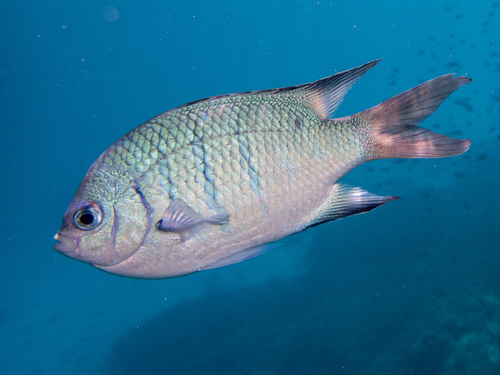
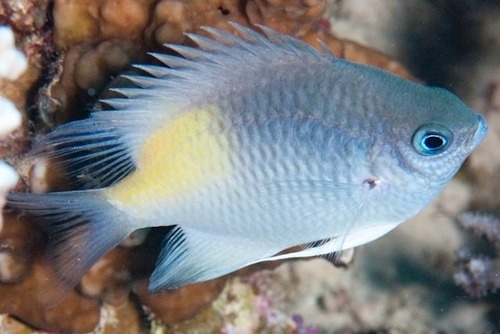
Its overall body color is pearly white: the anterior (front) half is grayish, the chest is mainly pearly white, and the posterior (rear) half is yellowish.
Etymology
This yellow coloration gives the species its Latin name flavilatus, which means "with yellow sides".
Territoriality
Like many other pomacentrid (damselfish) species, this fish is intensely territorial and competes for space both within its own species and with other species.
Algal Gardens
The territories it defends are called "algal gardens", which are large patches of algae that the fish cultivate and maintain.
Reproductive Influences
For some damselfish species, reproductive patterns are tied to periodic rainfall and wind changes in tropical regions, and some researchers note that the lunar cycle influences the synchronization of damselfish reproductive activity.
Habitat
Amblyglyphidodon flavilatus is a reef-dwelling fish, most commonly found on coastal fringing reefs and reef slopes.
Depth Range & Movement
It only occurs at depths between 12 and 20 meters (39 to 66 feet), and it is non-migratory, with no recorded movement away from its established home range.
Preferred Water Temperature
It prefers warm water with temperatures ranging from 72 to 78 °F (22 to 26 °C).
Distribution
This species is native to the western Indian Ocean, specifically the Red Sea and Gulf of Aden, where it occurs in Djibouti, Egypt, Eritrea, Israel, Jordan, Saudi Arabia, Somalia, Sudan, and Yemen.