About Abudefduf saxatilis (Linnaeus, 1758)
Size
Adults of Abudefduf saxatilis can reach a maximum total length of 22.9 cm (9.0 in), though most individuals grow to an average length of 15 cm (5.9 in). The heaviest recorded specimen of this species weighed 200 g (7.1 oz).
Fin Morphology
A. saxatilis has 13 dorsal spines, 12 to 13 soft dorsal rays, 2 anal spines, and 10 to 12 soft anal rays.
Base Coloration
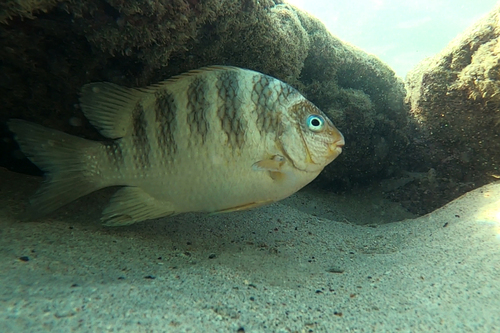
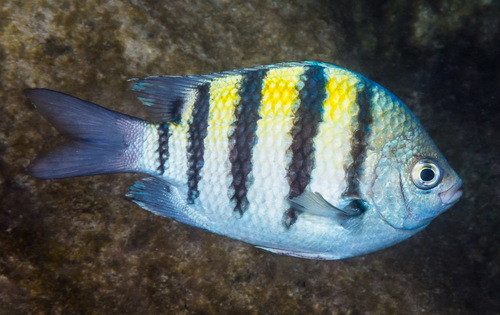
The fish has a white body with a yellow upper portion, and five vertical dark black or dark blue stripes. A faint sixth stripe may be present on the caudal peduncle.
Male Coloration
Mature males have a more bluish overall body color, with stripes that are less distinct than those of other individuals.
Pectoral Fin Marking
A dark spot surrounds each of the fish's pectoral fins.
Native Range
A. saxatilis is native to the Atlantic Ocean.
Western Atlantic Distribution
In the western Atlantic, populations occur from the northeastern coast of the United States, extending south through the Gulf of Mexico, the Bahamas, Caribbean islands, and along the eastern coast of Central America and South America all the way to Uruguay.
Eastern Atlantic Distribution
In the eastern Atlantic, this species is found from Portugal, the Azores, the Canary Islands, and Cape Verde, along western Africa.
Mediterranean Distribution Uncertainty
Its presence and distribution in the Mediterranean Sea remain unclear, as individuals can easily be confused with two related species: A. vaigiensis and A. troschelii.
Habitat by Life Stage
Juvenile sergeant majors are most commonly found in tidal pools, while adult individuals live on coral reefs.
Depth Range
The species occurs at depths down to 40 m (130 ft).
Reproductive Mode
The sergeant major is an oviparous species.
Spawning Site Selection
Males build nests on rocks, reef outcrops, shipwrecks, and pilings, where females deposit their egg masses.
Courtship and Egg Deposition
Males actively court females by chasing them before the female releases approximately 200,000 ovoid eggs.
Egg Characteristics
The eggs attach to the nest substrate via a filament, and turn greenish a few days after being laid.
Egg Guarding Behavior
After laying, the eggs are guarded by the male. While guarding the eggs, the male takes on a bluish color, and guards the clutch for around one week.