About Amazilia yucatanensis (S.Cabot, 1845)
Size and Weight
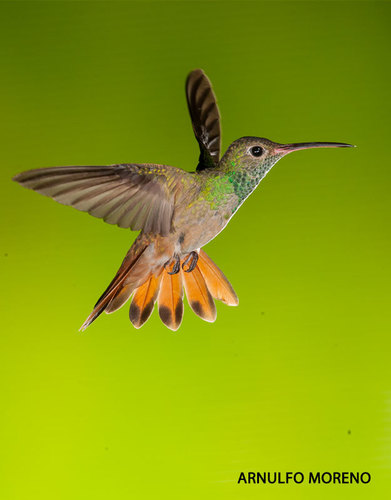
The buff-bellied hummingbird (Amazilia yucatanensis (S.Cabot, 1845)) measures 10 to 11 cm (3.9 to 4.3 in) in length and weighs 2.9 to 4.7 g (0.10 to 0.17 oz).
Bill Morphology
Adult males have a rosy reddish bill with a dusky tip, while females have more dark coloration on the upper bill (maxilla).
Nominate Male Upperparts
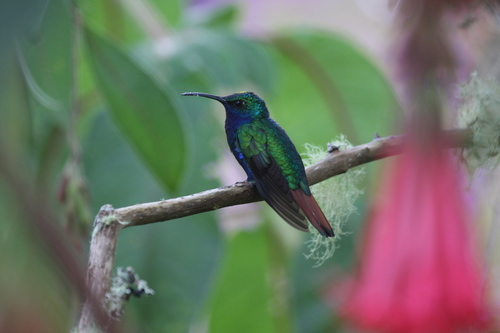
For the nominate subspecies, adult males have metallic bronze green upperparts that are duller and darker on the crown. Their uppertail coverts are a mix of bronze green and cinnamon rufous.
Nominate Male Tail Feathers
Their tail feathers are chestnut at the base and metallic bronze at the end.
Nominate Male Underparts
Their chin, throat, and chest are bright metallic yellowish emerald green, and their vent area and undertail coverts are deep cinnamon rufous.
Nominate Female Plumage
The adult female is similar to the male, but has a less iridescent back and throat. Its central tail feathers are mostly greenish bronze, and the outer tail feathers are mostly chestnut with greenish bronze edges and tips.
Subspecies A. y. chalconota Plumage
Subspecies A. y. chalconota has a bronze sheen on its upperparts, and its vent area and undertail coverts are light cinnamon-buff with interspersed bronze or bronze-green.
Subspecies A. y. cerviniventris Plumage
A. y. cerviniventris is very similar to chalconota, but has less bronze on the upperparts.
Nominate Subspecies Distribution
The nominate subspecies lives year-round from northern Belize and northwestern Guatemala north to Tabasco, Campeche, and Yucatán in southeastern Mexico.
Subspecies A. y. chalconota Distribution
A. y. chalconota occurs year-round from extreme southern Texas south through Mexico to north-central Veracruz, and can also be found further north and east in the United States during winter.
Subspecies A. y. cerviniventris Distribution
A. y. cerviniventris lives year-round from central Veracruz south through Puebla and Oaxaca to northern Chiapas.
General Habitat Characteristics
Across its year-round range, the buff-bellied hummingbird lives in a variety of landscapes, most of which are semi-open to open and rather dry.
Habitat Types
These habitats include scrubby woodlands, edges of denser forest, thorn forest, oak woodlands, oak "islands" in grasslands, and urban and suburban parks and gardens.
Winter Habitat Knowledge Gap
No detailed information is available about its habitat preferences in the United States during winter dispersal.