About Amaranthaceae
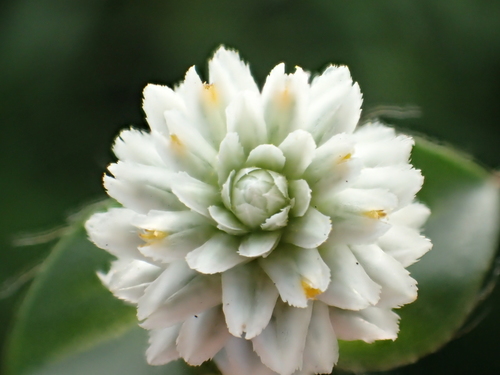
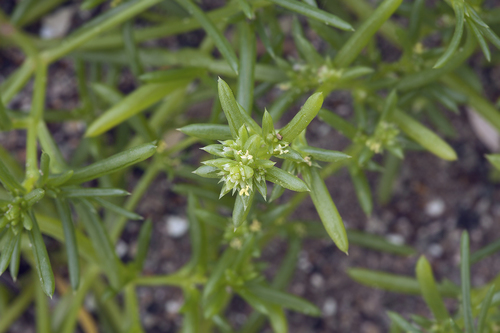
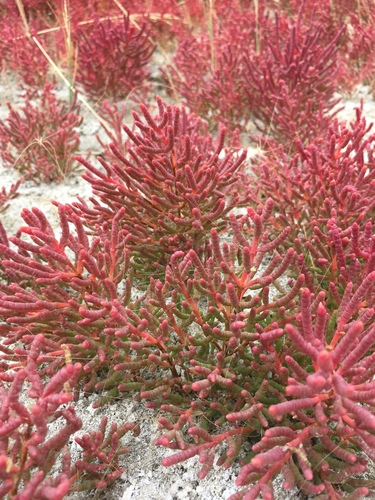
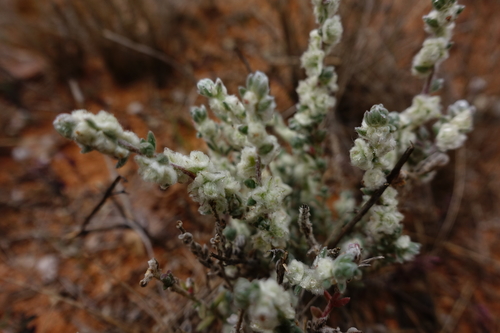
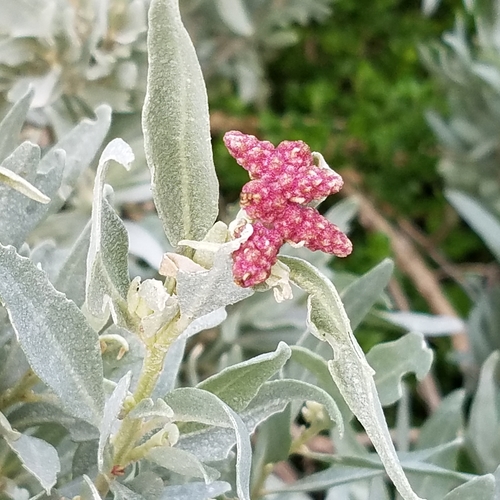
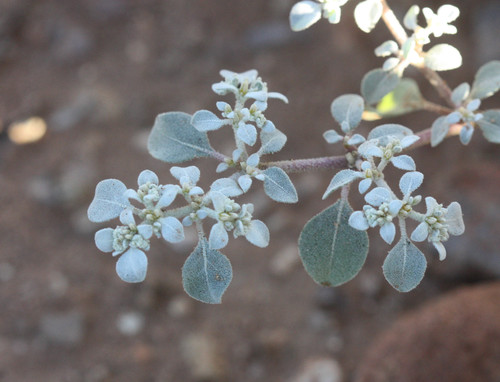
Most species in the Amaranthaceae are annual or perennial herbs or subshrubs; other species are shrubs, and very few are vines or trees. Some species are succulent, and many have stems with thickened nodes. Perennial stems have characteristic anomalous secondary wood growth, with normal secondary growth only found in the subfamily Polycnemoideae. Amaranthaceae leaves are simple, mostly alternate, and sometimes opposite; they never have stipules. Leaves are flat or terete, with extremely variable shape, and entire or toothed margins. Some species have leaves reduced to tiny scales, and most species do not form basal or terminal leaf aggregations. Flowers are either solitary or clustered into cymes, spikes, or panicles, and are typically perfect (bisexual) and actinomorphic, though some species have unisexual flowers. Bracts and bracteoles may be herbaceous or scarious. Flowers are regular, with a herbaceous or scarious perianth that most often holds five tepals (ranging from one to eight, rarely), and the tepals are often joined. One to five stamens are positioned opposite or alternating with tepals, inserted from a hypogynous disc; the disc may have appendages called pseudostaminodes in some species. Anthers hold two or four pollen sacs (locules). Members of tribe Caroxyloneae have anthers with vesicular appendages. Pollen grains are spherical and pantoporate (with many pores), with pore counts ranging from a few up to 250 in the genus Froelichia. One to three (rarely six) carpels fuse to form a superior ovary, which holds one (rarely two) basal ovule. Idioblasts are present in the plant tissues. Diaspores are either seeds or utricle fruits, and the perianth most often persists and becomes modified in the fruit to aid dispersal. In some cases, bracts and bracteoles are also part of the diaspore. More rarely, the fruit forms as a circumscissile capsule or a berry. Seeds are positioned either horizontally or vertically, and often have a thickened or woody seed coat. The green or white embryo is either spirally coiled (and lacks perisperm), annular, or rarely straight. Amaranthaceae is a widespread, cosmopolitan plant family found from tropical regions through cool temperate regions. Amaranthaceae sensu stricto is predominantly tropical, while the former Chenopodiaceae have their centers of diversity in dry temperate and warm temperate areas. Many species in the family are halophytes that tolerate salty soils, or grow in dry steppes or semi-deserts. Several species are used by humans. Spinach (Spinacia oleracea) and forms of beet (Beta vulgaris) including beetroot and chard are cultivated as vegetables. Other forms of Beta vulgaris include fodder beet (Mangelwurzel) and sugar beet. The seeds of Amaranthus, lamb's quarters (Chenopodium berlandieri), quinoa (Chenopodium quinoa) and kañiwa (Chenopodium pallidicaule) are edible and used as pseudocereals. Dysphania ambrosioides (epazote) and Dysphania anthelmintica are used as medicinal herbs. Several amaranth species, including members of the genus Salicornia (glasswort), are used indirectly as a source of soda ash. A number of species are popular garden ornamental plants, especially from the genera Alternanthera, Amaranthus, Celosia, and Iresine. Other species are classified as weeds, such as redroot pigweed (Amaranthus retroflexus) and alligatorweed (Alternanthera philoxeroides). Several species are problematic invasive species, particularly in North America, including Salsola tragus and Bassia scoparia. Many species in the family are known to cause pollen allergies.