About Alternanthera brasiliana (L.) Kuntze
Growth Habit
Alternanthera brasiliana (L.) Kuntze is an erect, sprawling herbaceous plant.
Size
It can reach up to 3 metres in height, though cultivated specimens usually grow to less than 1 metre.
Stem Characteristics
Its stems range in colour from red and green to purple; young stems are finely covered with hairs, while older stems become nearly hairless.
Leaf Features
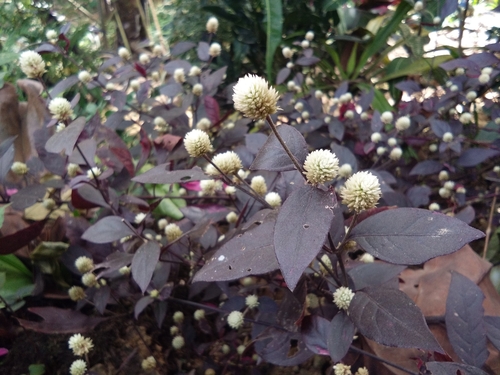
The plant bears opposite leaves that measure 1–10 cm long and 0.7–5 cm wide, and are typically purple-speckled or a luminous reddish-purple.
Deciduous Trait
In regions with slightly cool winters, it can lose some of its leaves, making it partially deciduous.
Flower Appearance
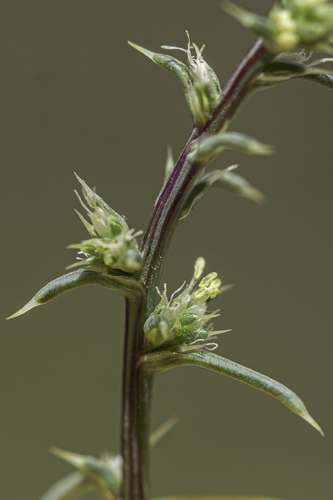
Its vanilla-coloured, pom-pom-shaped small flowers are arranged in compact clusters 7–20 mm long, borne in the upper leaf axils.
Flower Cluster Morphology
These clusters are rounded to slightly elongated, and grow on stalks that are usually 3–10 cm long.
Flowering Period
The plant can flower at any time of year, but it flowers most frequently in winter in temperate and cooler subtropical climates.
Fruit and Seed Features
It produces very small brown fruit 1.5–2 mm long, which holds a single seed that is usually concealed within persistent old flower parts.
Native Range
This species is native to Brazil, Peru, Ecuador, Colombia, Venezuela, the Guyanas, Nicaragua, Belize, Guatemala, Mexico, northeastern Argentina, Trinidad and Tobago, Aruba, and the Windward Islands.
Naturalised Distribution
It has become naturalised in wild areas and cultivated land in West Africa, coastal districts of northern and eastern Australia, Florida, South Africa, several Pacific Islands, and on shaded ravine slopes and along creeks in Java.
Weed Classification
Like most joyweed species, Alternanthera brasiliana is classified as an environmental weed in Queensland, New South Wales, the Northern Territory, and Western Australia.
Ornamental Cultivars
The plant is grown as an ornamental, with many existing cultivars including 'Purple Prince' and 'Little Ruby', which are classified as cultivars of Alternanthera brasiliana var. villosa.
Traditional Uses
It is often harvested from the wild for local use as food and medicine, where it is employed as an antiviral and anti-diarrhoea treatment.
Cultivation Requirements
It grows best in full sun in moist, well-drained soil, and spreads readily through self-seeding.
Propagation Method
It can also be easily propagated from stem cuttings.