About Alternanthera bettzickiana (Regel) G.Nicholson
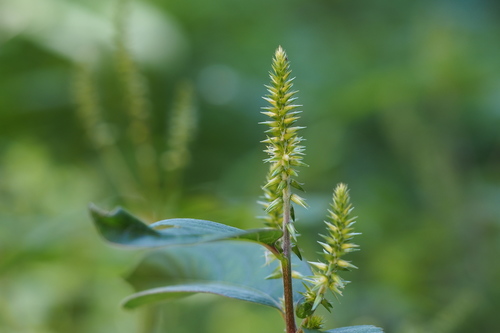
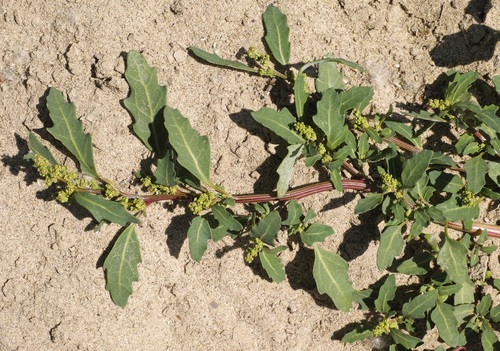
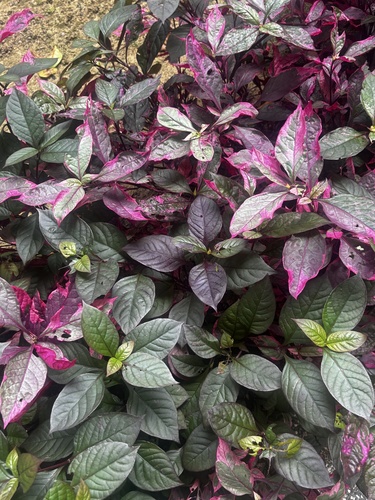
Alternanthera bettzickiana is a perennial herb that grows 20 to 50 cm tall and produces variegated leaves. Its branched stems are circular in cross-section near the base and quadrangular towards the top. The stems have small hairs at their nodes, apex, and on the short petioles, which are 1 to 4 mm long. The leaf blade measures 1 to 6 cm long and 0.5 to 2 cm wide. Leaf color can be green, red, or green tinged with either red or yellow. Leaf shape is oval, sometimes slightly oblong or spatulate, and the leaf margin is not flat but slightly wavy. Flowering occurs at the end of summer. Inflorescences are either terminal or axillary, with 2 to 5 growing on each flower stalk. The bracts are 1.5 to 3 mm long and acuminate. The corolla and calyx are made up of white tepals; the outermost tepals are longer at 3 to 4 mm and hairier than the inner tepals. This species has 5 stamens with linear anthers, and a smooth ovary with a very short style. This plant is particularly popular in China, where it is cultivated in nearly all large cities. It grows best in full sun to partial shade. It has become naturalized in southeastern Queensland, Australia, where it grows in woodlands, and can also be found along roads that pass through rainforest. The plant's edible leaves are harvested from the wild, and these leaves may be helpful for anaemic children.