About Alloxylon pinnatum (Maiden & Betche) P.H.Weston & Crisp
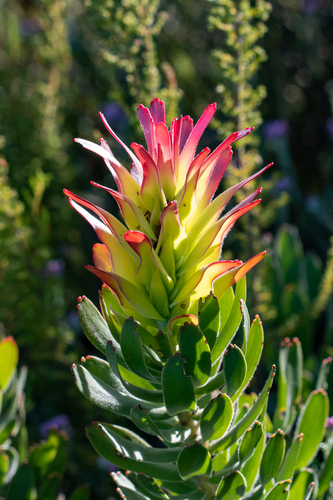
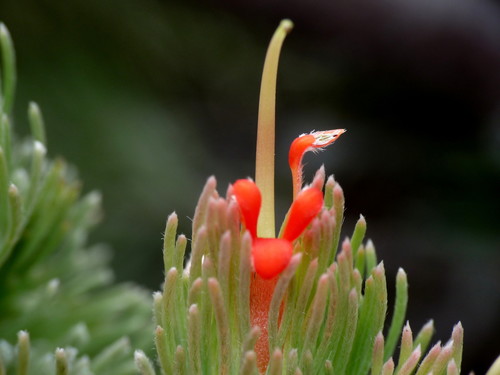
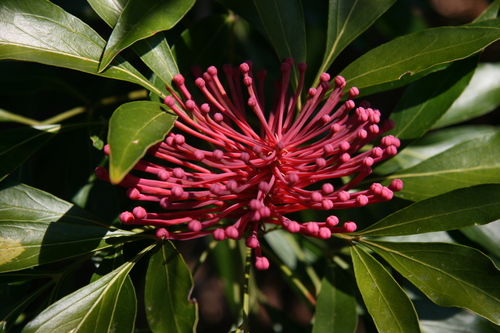
Alloxylon pinnatum, commonly known as Dorrigo waratah, is a species of rainforest tree. It grows up to 25 m (82 ft) high, with a non-buttressed trunk reaching 1.5 m (5 ft) in diameter at breast height. Its greyish brown bark is covered in many small pimples, giving it a sandpaper-like texture. Its green foliage is arranged alternately along stems, and has distinct juvenile and adult leaf forms. Juvenile leaves are light green and start as simple leaves with a single blade. As the plant matures, later leaves become more complex and pinnate with deep lobes, reaching up to 30 cm (12 in) long with 2 to 11 leaflets. Some adult leaves are simple, consisting of a single lanceolate leaf blade up to 15 cm (5.9 in) long, and these are generally found near the flower heads. Occasional yellow leaves appear among the green foliage. New branchlets and new leaves are covered in brown hair. Pinkish-red compound flower heads, called inflorescences, grow up to 20 cm (8 in) across from spring to summer, holding between 50 and 140 smaller flowers arranged in a corymb or raceme. Individual flowers measure 3–3.8 cm (1.2–1.5 in) long and sit on stalks (pedicels) up to 3.5 cm (1.4 in) long; these pedicels arise in pairs from the main stalk inside the inflorescence. Each flower has a tubular perianth that partially splits along one side when it blooms to release the thick style. The stigma sits inside a slanted disc-shaped structure at the tip of the style. The tubular perianth splits into four segments at its tip, and an anther sits in a concave area on each segment. All flower parts are smooth and hairless, and the pollen is crimson. After flowering, woody cylindrical seedpods 8–10 cm (3.1–3.9 in) long develop. The seedpod splits along one side to release ripe seeds between February and June. Seeds are arranged in two rows, with at least four seeds per row. Each seed is separated from others by a membranous separator, and has a long rectangular wing that is much longer than the seed itself. Dorrigo waratah can be distinguished from other species in the genus Alloxylon by its pinnate adult leaves, as all other species in the genus have simple adult leaves. Other Alloxylon species also produce inflorescences with at most 50 flowers, and have yellow pollen. Dorrigo waratah occurs in warm-temperate rainforest at altitudes between 700 and 1,250 m (2,300 to 4,100 ft), along the McPherson Range in south-east Queensland and the Dorrigo Plateau in northern New South Wales, growing alongside dominant tree species such as coachwood (Ceratopetalum apetalum) and Antarctic beech (Nothofagus moorei). In Queensland, it is also associated with golden sassafras (Doryphora sassafras) and native crabapple (Schizomeria ovata). It commonly grows on the southern-facing aspects of hills and slopes. Dorrigo waratah’s bright, clearly visible flowers and its ability to attract birds make it a desirable garden plant. It only reaches about 6–10 m (20–33 ft) tall when grown in cultivation, but it has proven difficult to cultivate. It has been grown successfully at the Australian National Botanic Gardens in Canberra, in a sheltered, partially shaded location with a thick layer of mulch. It is most easily propagated by seed; seeds ripen from February to June and remain viable for around twelve months. Seedlings often die when they reach 15 cm (6 in) high, and are hard to transplant. It has also been grown at Mount Tomah Botanic Garden, where it was observed to have very specific growing requirements, needing excellent drainage and a sheltered location to survive. It is a slow-growing plant: specimens planted in 1989 first began flowering in 1999. The much easier-to-grow Queensland tree waratah (Alloxylon flammeum) has been considered for use as grafting stock for Dorrigo waratah. Its pinkish red timber is soft and light, with a weight of 500 kg (1100 lb) per cubic metre, and has been used to make cabinets and furniture. Its cut flowers have a long vase life.