About Agonus cataphractus (Linnaeus, 1758)
Species Naming and Body Plating
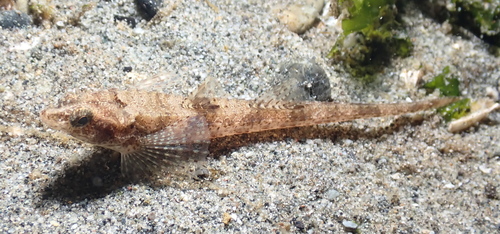
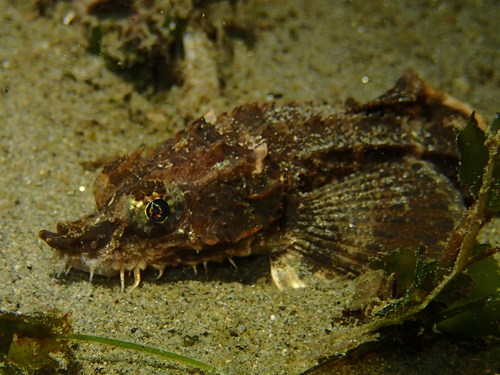
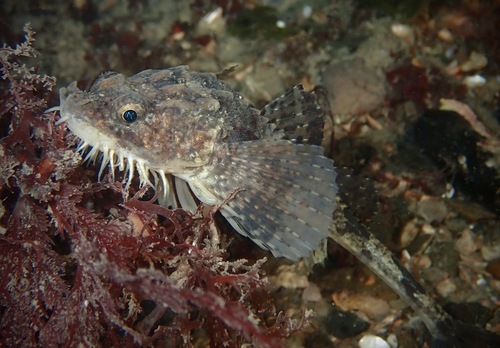
The species Agonus cataphractus, commonly known as Agonus, has the entire head and body covered in hard bony plates. The body plates are jointed to allow the fish to move.
Head Spines
A robust curved spine sits on the lower edge of the operculum, and another two-tipped curved spine is located at the end of the snout. The underside of the head has many short barbels.
First Dorsal Fin Structure
The first dorsal fin has a short base, supported by 5 or 6 flexible spines.
Second Dorsal Fin Structure
The second dorsal fin has a longer base, holding 6 to 8 soft rays.
Anal Fin Structure
The anal fin matches the second dorsal fin in shape, and contains between 5 and 7 soft rays.
Tail and Caudal Fin
This fish has a slender tail that ends in a small caudal fin.
Coloration
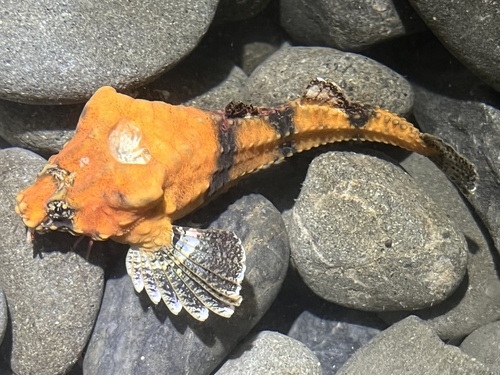
Its upper body is dull brown, marked with four dark saddle-shaped patches along the back, while its lower body is pale.
Size
The maximum recorded total length for this species is 21 cm (8.3 in), though 14 cm (5.5 in) is a more common adult size.
General Distribution
Agonus cataphractus occurs in coastal waters of the northeastern Atlantic Ocean. Its range extends from the southern White Sea, around Jan Mayen, through the Barents Sea, Norwegian Sea, Baltic Sea and North Sea, and reaches south as far as the English Channel.
Habitat Movement Patterns
It most commonly lives in inshore waters, and individuals in the Skagerrak move to deeper waters during winter.
Substrate Preference
It usually inhabits sandy substrates, and is occasionally found on stony bottoms.
Depth Range
It can be found at depths ranging from 0 to 270 m (0 to 886 ft).